
5 Ways to Track Your Sleep
Wearables, Nearables, and the Consensus Sleep Diary
Revised: 7/12/2026 | By Dan Gartenberg, PhD
SleepSpace is a sleep operating system because it can track your sleep in many different ways. We just introduced a new algorithm for more accurately measuring sleep using only the sensors of your phone. We call this technology 'nearable' sleep sensing. But simply tracking sleep is a thing of the past. We built SleepSpace to enhance your sleep. Now you can simply place your phone on your mattress and our patented smart sound machine will adjust sounds based on your sleep cycles in order to increase regenerative deep sleep.
1. Wearables
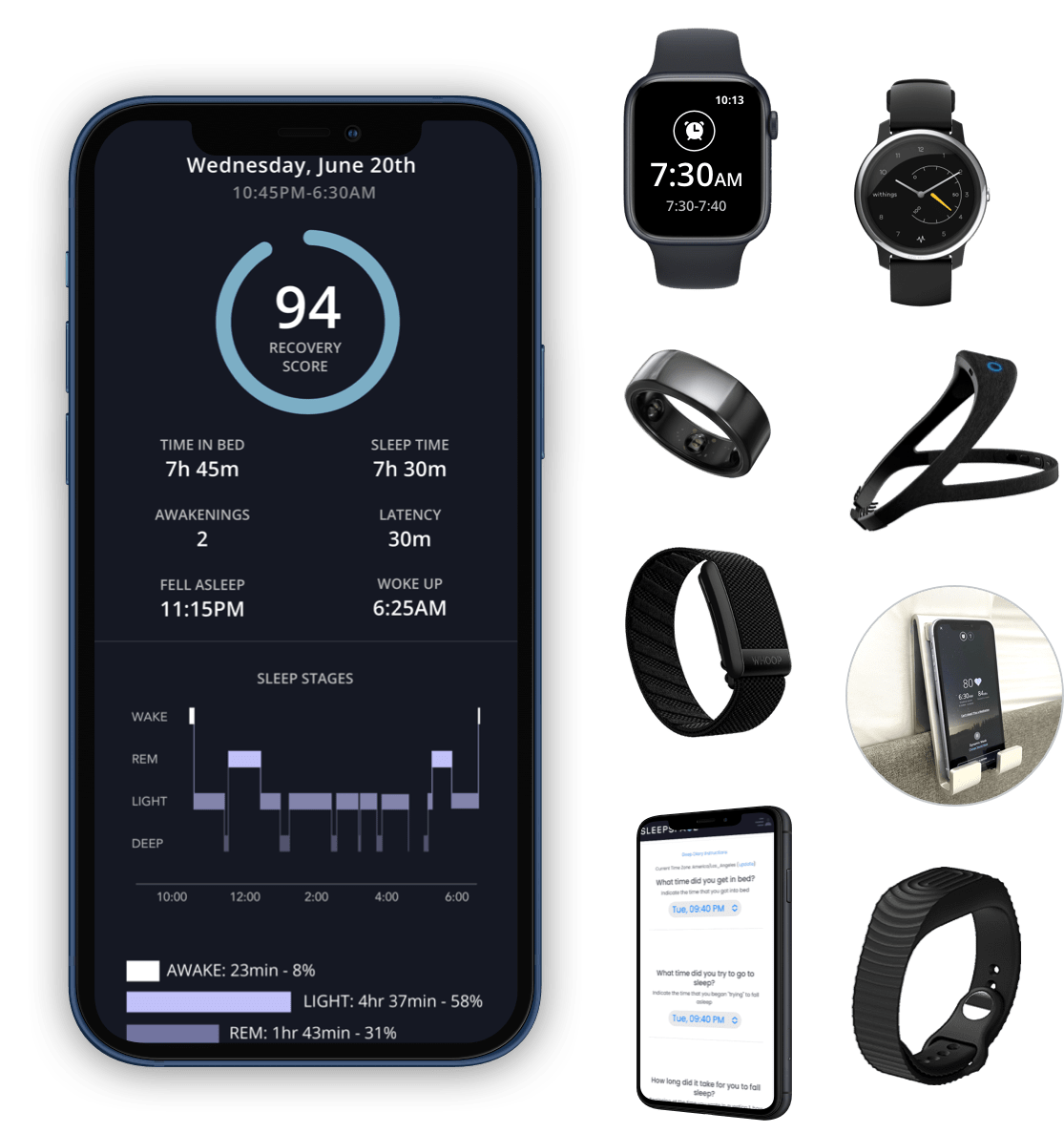
The most accurate way to measure sleep is with a wearable because heart rate is needed to precisely predict sleep stages. That's why SleepSpace integrates with most wearables (see a full list). Our deep sleep stimulation algorithm works best when you use SleepSpace alongside an Apple Watch. Don't have an Apple Watch? No problem! Read on to find another sleep enhancing solution that works for you.
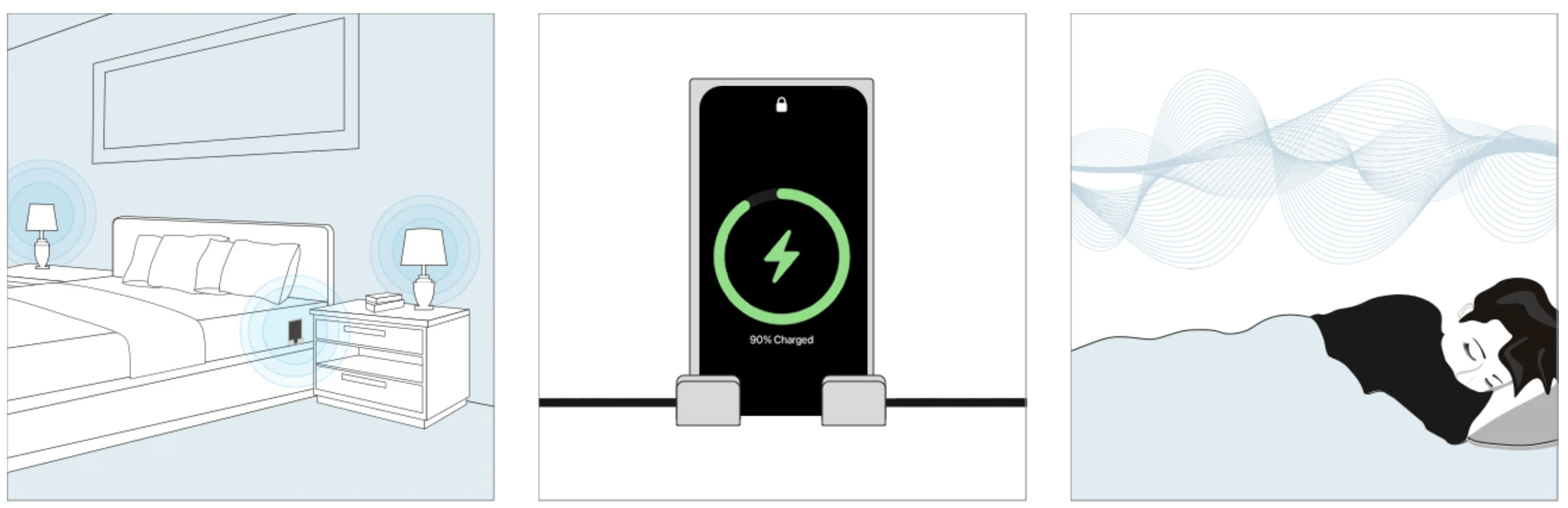
The smart bed is another extremely accurate way of enhancing sleep, that is slightly less accurate than a wearable. But it has many other advantages, such as putting your phone away from you at night, charging your phone, and more precisely playing deep sleep stimulation sounds. It more precisely plays these sounds because the phone speaker is located in the same place every night and we developed a patented phone-based algorithm that picks up on micro-motions through your mattress in order to determine the right time and volume for playing the adaptive sounds.
3. Place your phone on your mattress
Now you can simply place your phone on your mattress to accurately measure and enhance your sleep. No extra gizmos or sensors are required. While this is slightly more invasive than the smart bed, and could be less accurate at enhancing sleep with sounds, it is still one of the most precise ways to measure sleep available on the market.
4. Place your phone on your bedside table
Do you find it difficult to not use your phone at night, but don't want to purchase the smart bed? Then we recommend placing your phone on a nightstand that is out of reach. Your sleep will not be measured as accurately as the other methods, but you will still receive the regenerative power of our wind down, smart sleep, and wake up experience. We recommend not enabling the deep sleep stimulation functionality when you are using SleepSpace on a bedside table.
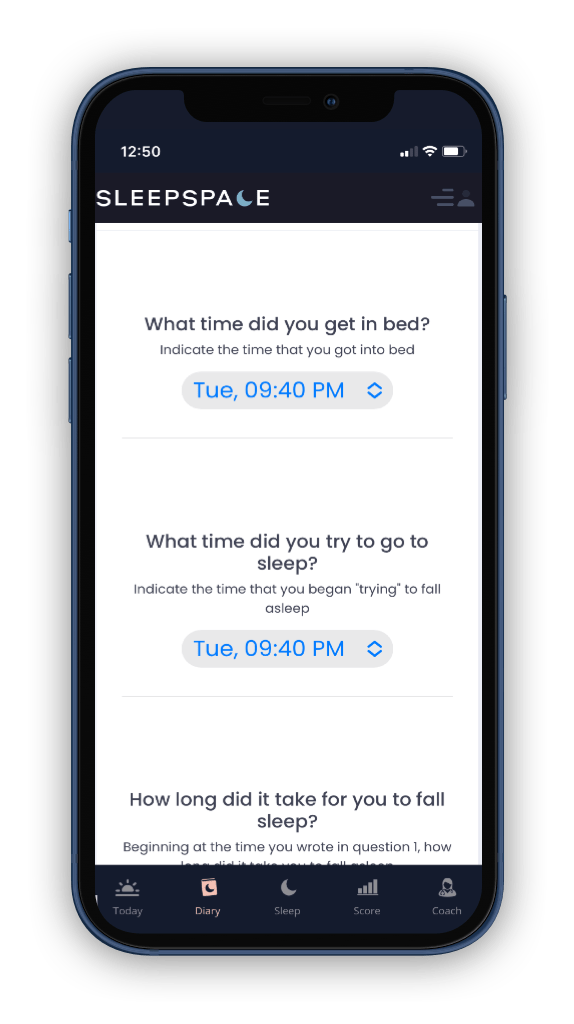
How you perceive your sleep is actually one of the most accurate ways to evaluate your sleep. That's why we built a digital version of the consensus sleep diary. This method of measuring your sleep is particularly helpful if you have problems falling asleep and staying asleep. Also, the sleep diary can be used alongside the other sleep tracking methods.
Concerned about your phone disrupting your sleep and EMFs? That's why we built SleepSpace to work completely offline!
Track sleep better
The best way to track sleep depends on what you need to learn
You do not need one perfect device to track sleep well. You need the right signal for the problem in front of you. Sometimes that means a wearable. Sometimes it means a phone-based sleep tracker. Sometimes the most useful tool is a digital sleep diary you actually complete every morning.
A good sleep tracker app should help you answer practical questions. Are you trying to understand sleep timing, sleep stages, awakenings, snoring, insomnia patterns, or whether your routine is getting more consistent from week to week? [1] [2] [3]
The strongest setup is often a combination of subjective and objective tracking. Device data can show trends you would miss, while a sleep diary shows how the night actually felt, how long you believe you were awake, and what changed in your routine. [1] [4]
SleepSpace is useful here because it does not force you into one path. You can track sleep with your phone on the nightstand or mattress, use the digital sleep diary, connect Oura and other wearables, and review everything inside the same feedback loop. If you want the broader product walkthrough behind that system, the How It Works page is also worth reading.
Compare the options
Choose the sleep tracking method that matches your routine, not just the newest device
1. Wearables
Use a wearable when you want the richest physiological picture
Apple Watch, Oura, WHOOP, and similar wearables are useful when heart rate, heart-rate variability, and sleep-stage estimates help you understand recovery and continuity across multiple nights. [3] [5] [7]
If you already have a device, start with the Oura and Apple Watch comparison , the Apple Watch connection page, and the guide on using wearables with SleepSpace.
2. Smart bed
Use the SleepSpace Smart Bed when you want passive tracking with consistent phone placement
This is a strong option if you want phone-based sensing without wearing a watch or ring overnight, while also keeping the speaker location and nightly setup more consistent.
That is especially helpful if you care about sleep enhancement as well as sleep tracking, because sound delivery and placement matter when you want a smoother bedtime workflow.
3. Phone on mattress
Use mattress placement when you want to track sleep without a wearable
If you do not want to wear anything, placing your phone on the mattress can be a practical middle path between passive sensing and low friction. [2]
This is one of the clearest paths for anyone looking for a sleep tracker without a watch or a more minimalist phone sleep tracker setup.
4. Phone on nightstand
Use bedside tracking when routine simplicity matters more than maximum precision
Nightstand placement works well if your first goal is consistency, wind-down support, smart alarm use, sound review, and a lower-friction way to track sleep over time.
Pair it with real-time sleep tracking and Sleep Score review so the morning feedback has some context behind it.
5. Consensus sleep diary
Use a sleep diary when insomnia, awakenings, or clinician review are central
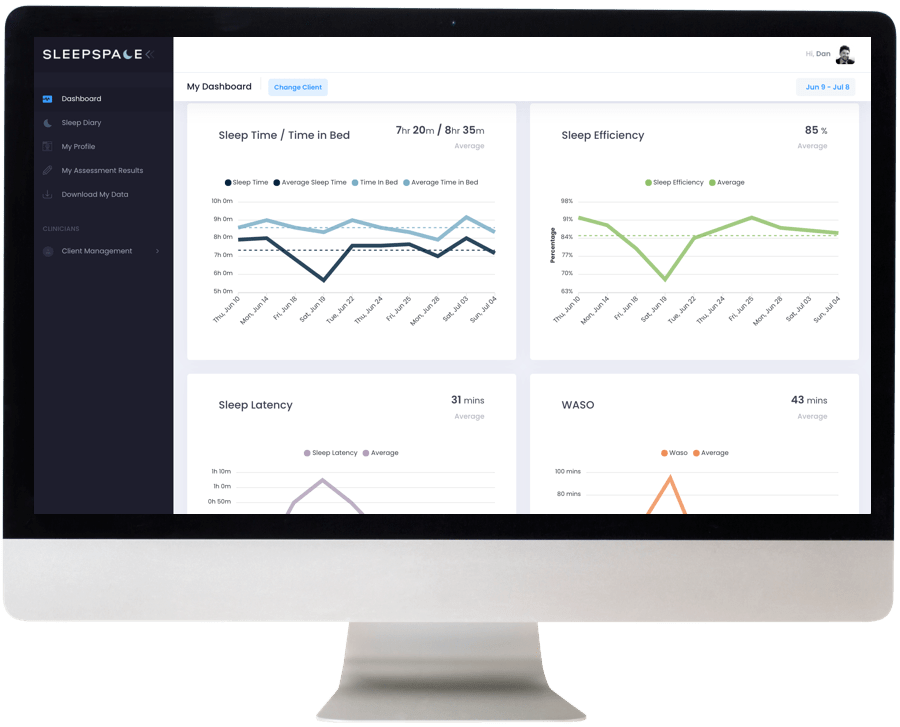
A sleep diary is often the best way to track sleep when the core question is sleep onset latency, wake after sleep onset, time in bed, sleep efficiency, or whether your experience of the night is changing. [1] [6]
SleepSpace includes the Consensus Sleep Diary in digital form, which makes it much easier to review with a sleep coach or clinician.
Subjective plus objective
A sleep diary still belongs in the stack even if you already use Apple Watch, Oura, or WHOOP
A lot of sleep problems are not solved by another number. They are solved by seeing the pattern more clearly. If insomnia is part of the picture, the diary often becomes the anchor because it shows sleep latency, awakenings, perceived sleep quality, and whether the night felt better or worse than the device suggested. [1] [6]
This is also one of the best ways to reduce orthosomnia. If tracking has started to make you more tense, use the sleep diary and the rest of your Sleep Score as a feedback loop, not a verdict. [6]
The other practical advantage is review. A clinician or coach can understand a cleaner story when diary entries, sound, and device data live together instead of across disconnected apps and screenshots.
Phone-based sleep tracking
Track sleep without a wearable if that fits your routine better
If the main reason you are not tracking sleep is that you do not want one more thing attached to your body, phone-based tracking is a legitimate starting point. It lowers friction and makes it easier to build the routine before you decide whether more sensors would actually help. [2] [3]
That is where SleepSpace is different from a basic sleep monitor. You can start with the phone, add snoring and sound review, use the schedule tools, and connect a wearable later if you decide the extra physiology is worth it.
If you already know you prefer a no-wrist setup, keep the phone placement consistent and review several nights before making decisions about accuracy or progress.

Interpret the pattern
Sleep tracking works best when you review a week of trends, not one dramatic night
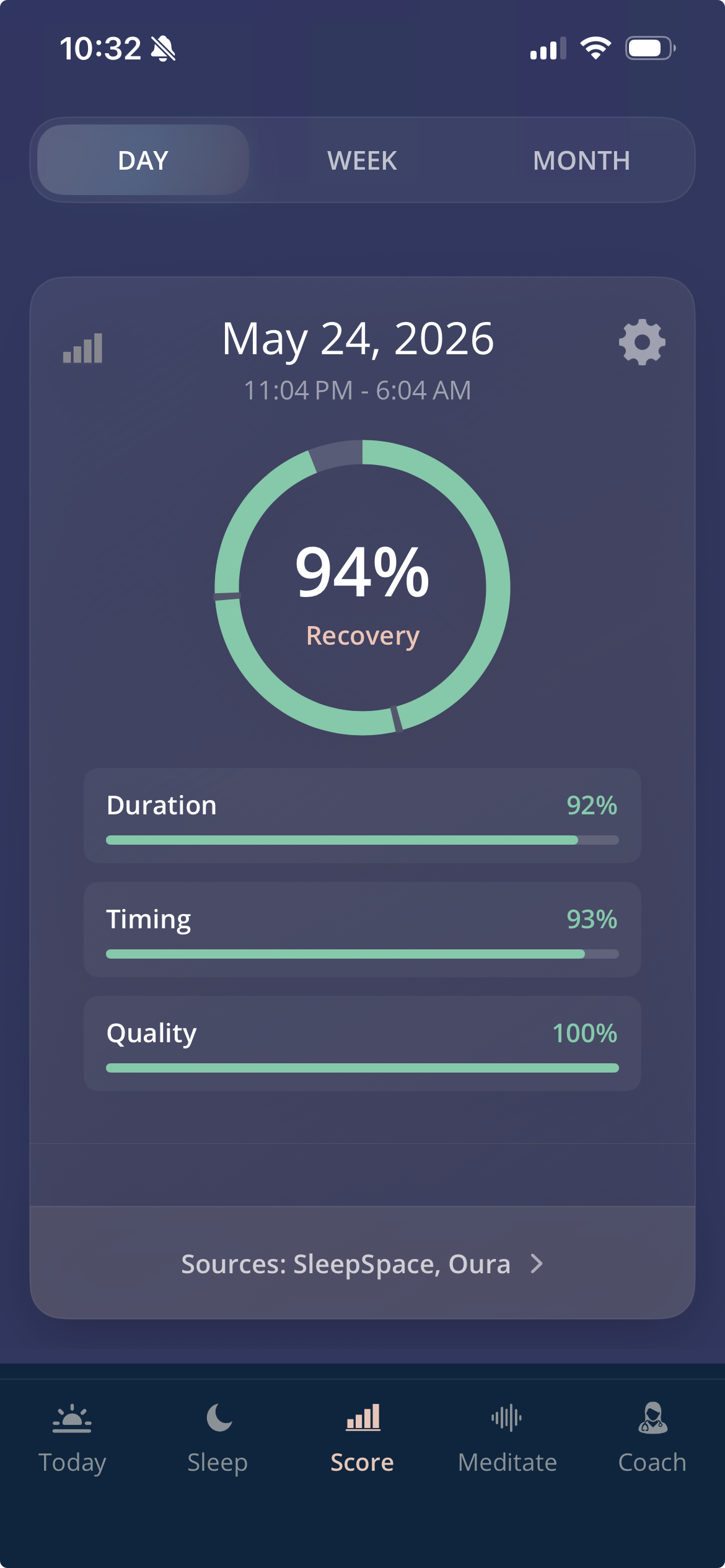
Single-night sleep data is noisy. Travel, alcohol, stress, illness, bedtime drift, late exercise, and room noise can all distort the picture. Multi-night review is where a sleep tracker becomes more than a novelty. [3] [4] [5]
Use the Sleep Score to see the morning summary, but also compare it with your diary, your snoring or sound review, and your real-time tracking so you know what to do next.
If you use more than one device, the compare device data page is especially relevant because it shows how SleepSpace can line up multiple device streams instead of forcing you to trust one source in isolation.
If you want the evidence and product context behind that broader approach, the SleepSpace science page is the best internal place to keep reading.
Keep exploring
Related SleepSpace resources that make sleep tracking more useful
SleepSpace resource
Digital sleep diary
Best for insomnia, awakenings, time in bed, and nights where the subjective story matters as much as the device output.
SleepSpace resource
Real-time sleep tracking
Helpful if you want to move from passive logging into a more active nightly review and in-app feedback loop.
SleepSpace resource
Using wearables and other devices
Useful if you want to keep your current device and understand how it fits into the broader SleepSpace workflow.
SleepSpace resource
Connect Apple Watch
Best for Apple-first users who want stronger sleep-tracking accuracy, biofeedback, and a clearer picture of how the watch fits into the SleepSpace system.
SleepSpace resource
Sync SleepSpace with Oura and other wearables
Start here if you already own a tracker and want the data inside one app instead of in another silo.
SleepSpace resource
Compare device data
Useful if you want to line up sleep data from more than one tracker and see how SleepSpace helps you interpret the differences.
SleepSpace resource
Understanding your Sleep Score
Useful if you want the morning score to tell you something actionable instead of becoming another number to stare at.
SleepSpace resource
How It Works
Useful if you want the broader product walkthrough showing how sleep tracking, interventions, coaching, and device support fit together.
SleepSpace resource
SleepSpace science page
Use this if you want the internal literature and evidence hub behind the tracking, diary, recovery, and behavior-change framing.
FAQ
Common questions about how to track sleep
What is the best way to track sleep?
The best method depends on the question. Wearables are useful for physiological trends. A sleep diary is often better for insomnia patterns. Phone-based tracking can be the easiest place to start if you do not want another device.
Can I track sleep accurately without a wearable?
Yes. You can learn a lot from consistent phone placement, a digital sleep diary, and multi-night review. A wearable can add more context, but it is not the only useful option.
Are sleep trackers accurate?
They can be very useful for trends, but no consumer tracker is perfect in every condition. Quiet wakefulness, fragmented sleep, and edge cases still benefit from diary context and broader interpretation.
Why use a sleep diary if I already have Apple Watch or Oura?
The diary captures your experience of the night, which matters for insomnia, awakenings, and how the night actually felt. It also helps keep one morning score from becoming the whole story.
Can SleepSpace work as a sleep tracker without a watch or ring?
Yes. You can start with phone-based tracking and the Consensus Sleep Diary, then add a wearable later only if it improves the picture for your goals.
What if tracking data makes me more anxious about sleep?
Shift more weight onto the diary, look at weekly patterns instead of one night, and treat the data as guidance rather than a judgment. If the tracking is increasing pressure, simpler review is often better.
References
Selected references on sleep diaries, wearables, and phone-based sleep tracking
- Carney CE, Buysse DJ, Ancoli-Israel S, et al. The Consensus Sleep Diary: Standardizing Prospective Sleep Self-Monitoring. Sleep. 2012.
- Behar J, Roebuck A, Shahid M, Daly J, Hallack A, Palmius N, Stradling J, Clifford G. A review of current sleep screening applications for smartphones. Physiological Measurement. 2013.
- de Zambotti M, Menghini L, Baker FC, et al. State of the Science and Recommendations for Using Wearable Technology in Sleep and Circadian Research. Sleep. 2023.
- Bianchi MT. Consumer sleep monitors: is there a baby in the bathwater? Nature and Science of Sleep. 2015.
- Roberts DM, Schade MM, Mathew GM, Gartenberg D, Buxton OM. Detecting sleep using heart rate and motion data from multisensor consumer-grade wearables, relative to wrist actigraphy and polysomnography. Sleep. 2020.
- Baron KG, Abbott S, Jao N, Manalo N, Mullen R. Orthosomnia: Are Some Patients Taking the Quantified Self Too Far? Journal of Clinical Sleep Medicine. 2017.
- de Zambotti M, Rosas L, Colrain IM, Baker FC. The Sleep of the Ring: Comparison of the OURA Sleep Tracker Against Polysomnography. Behavioral Sleep Medicine. 2017.
Next step
Start with the tracking method you will actually use tonight, not the one that sounds most advanced on paper. If you want one place to combine the Consensus Sleep Diary, phone-based tracking, sleep score review, sound data, and optional wearables, SleepSpace gives you that path without forcing you into one device model.