
Keeping a regular sleep schedule
Created by Dr. Daniel Gartenberg, NIH-funded sleep scientist, CEO of SleepSpace
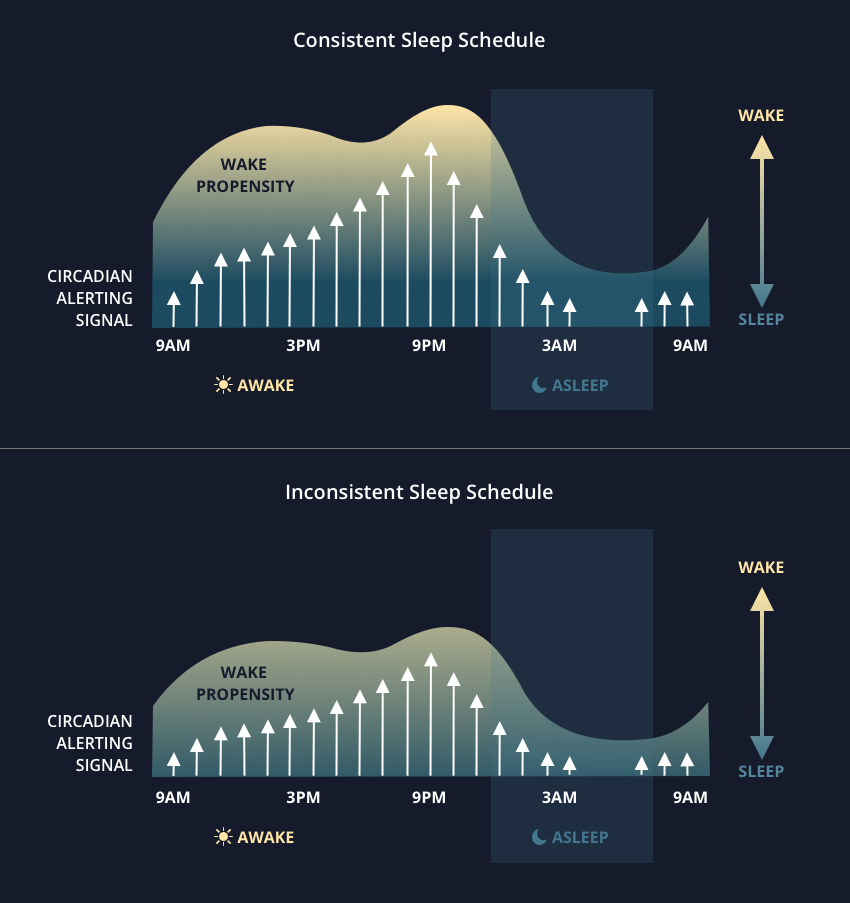
A regular sleep schedule is one of the strongest ways to improve sleep health and deep sleep because it strengthens your circadian rhythm and gives your sleep drive a pattern to trust.
Most people do not need a perfect bedtime. They need a sleep goal, a repeatable wake time, less weekend drift, and a better way to notice when one rough night turns into three because the schedule keeps moving. [1] [2] [3]
Best practice for better sleep
One of the best things you can do to improve your sleep quality is to set a regular sleep schedule and stick to it. Following a set bedtime and wake-up time will regulate your sleep/wake cycle, establish a healthy sleeping pattern, and strengthen your circadian rhythm - thereby making you tired at the right time and alert at the right time.
Sleep goals
Setting your sleep goals will help you improve your sleep drive and consolidate your sleep. Following the sleep schedule found in the Sleep tab of the app will regulate your sleep/wake cycle, establish a healthy sleeping pattern, and strengthen your circadian rhythm.
Scientific read
The reason schedule regularity works is that it strengthens the timing relationship between your circadian rhythm and your sleep behavior. A regular wake time stabilizes morning light exposure, helps sleep pressure build more predictably, and lowers the odds that each night becomes its own separate negotiation. [1] [3]
This is also why weekend drift matters more than people expect. A large weekday-weekend gap can create a social-jet-lag pattern. You may not notice it as "jet lag," but your Monday biology often does - when you may experience increased sleep inertia. The body clock does not care that the time-zone shift came from brunch instead of an airplane. [2] [7]
Late wake time can push the whole system later. Evening blue-enriched light can do the same thing from the other direction (why red-light is better). That combination is why many people feel like they are trying hard and still losing. They are often sleeping against a moving clock rather than simply sleeping badly. [3] [4]
What I like about this topic for SleepSpace is that the software can actually support the boring part that matters most: a repeatable wake cue, better diary visibility, more deliberate wind-down, and a way to watch whether consistency is really improving rather than just sounding virtuous. [5]
What to track if you want schedule advice to become a real plan
Track bedtime, wake time, weekend drift, naps, and whether you are sleeping in after a bad night. Most schedule problems become obvious only after you look across several days instead of judging a single night in isolation. [1] [5]
That is where a diary still beats vibes. SleepSpace makes this useful because the same app that captures the pattern can also help you test a tighter wake-time anchor, a better wind-down, or a different morning cue the very next day. [5]
References
1. Phillips AJK, Clerx WM, O'Brien CS, et al. (2017). Irregular sleep/wake patterns are associated with poorer academic performance and delayed circadian and sleep/wake timing.
This is one of the clearest papers showing that regularity itself matters, not just total sleep opportunity.
2. Roenneberg T, Allebrandt KV, Merrow M, Vetter C. (2012). Social Jetlag and Obesity.
Useful for explaining why weekday-weekend drift behaves like a small recurring time-zone shift.
3. Burgess HJ, Eastman CI. (2006). A late wake time phase delays the human dim light melatonin rhythm.
Important support for why wake time gets treated as such a strong anchor in schedule-reset advice.
4. Chellappa SL, Steiner R, Blattner P, et al. (2013). Acute exposure to evening blue-enriched light impacts on human sleep.
Useful for explaining why late light and late screen exposure can push the whole schedule later.
5. Carney CE, Buysse DJ, Ancoli-Israel S, et al. (2012). The Consensus Sleep Diary: Standardizing Prospective Sleep Self-Monitoring.
The diary citation helps support the tracking and experimentation side of the page.
6. Duncan MJ, Kline CE, Vandelanotte C, et al. (2016). Greater bed- and wake-time variability is associated with less healthy lifestyle behaviors: a cross-sectional study.
Useful practical support for why variability often travels with other behaviors that destabilize sleep.
7. Vitale JA, Roveda E, Montaruli A, et al. (2015). Chronotype influences activity circadian rhythm and sleep: differences in sleep quality between weekdays and weekend.
Helpful for showing how chronotype and weekday-weekend differences interact in real life.