
Sleep restriction and sleep compression
Spend less awake time in bed so sleep can consolidate
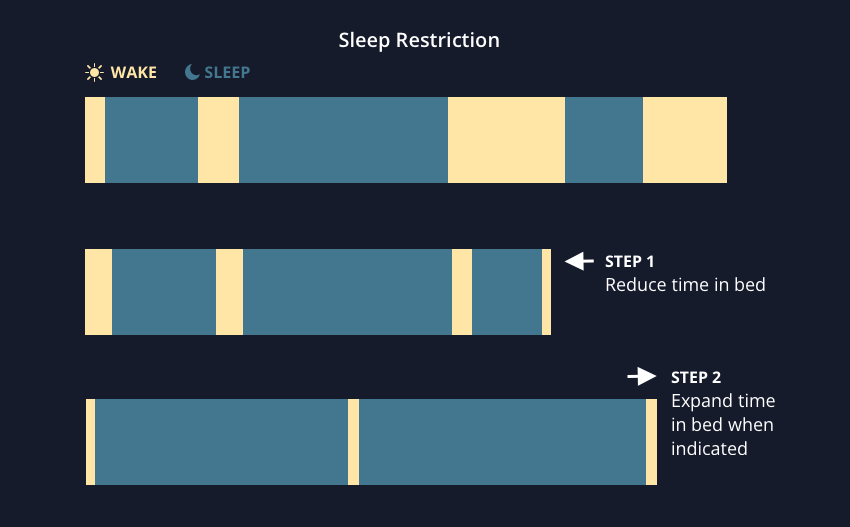
Sleep restriction therapy has a harsh name, but the goal is not to deprive you. The goal is to match time in bed more closely to actual sleep, build sleep drive, and gradually expand the sleep window as sleep becomes more efficient.
Sleep restriction and sleep compression reduce time in bed to build up sleep drive and consolidate sleep. Usually that means moving bedtime later, keeping wake time steady, and using a sleep diary to see whether more of the time in bed is actually spent asleep.
The common insomnia instinct is to go to bed earlier because you feel desperate for more sleep. But if the extra time becomes awake time, the night can stretch into a thin, frustrating block. Sleep restriction and compression work in the opposite direction: make the sleep opportunity more realistic first, then expand it when efficiency improves. [2] [3]

Keywords
Guideline status
UsedThe American Academy of Sleep Medicine suggests sleep restriction therapy as a single-component therapy for adults with chronic insomnia disorder. [1]
Original evidence
1987Spielman and colleagues described restricting time in bed, then extending it based on improved sleep efficiency, with benefits maintained at follow-up. [2]
Primary care RCT
642The HABIT trial tested nurse-delivered sleep restriction therapy in primary care among 642 adults with insomnia disorder. [3]
Restriction vs compression
Two ways to reduce excess awake time in bed
Sleep restriction therapy
Sleep restriction sharply reduces the amount of time spent in bed to more closely match actual sleep time. The sleep window is then gradually expanded when sleep becomes more consolidated.
This approach can be effective, but it can feel difficult at first and should be used carefully when sleepiness creates safety risks.
Sleep compression
Sleep compression is a gentler version. Instead of a sudden reduction in time in bed, time in bed is gradually reduced until it better matches actual sleep time.
Compression may be more tolerable for some people, including older adults or people who need a slower adjustment, though it is generally less studied than sleep restriction. [4] [6]
The 85% idea
In sleep restriction and sleep compression plans, 85% sleep efficiency is often used as a practical signal that the sleep window may be working. Sleep efficiency means the percentage of time in bed that is actually spent asleep.
For example, if you spend 7 hours in bed and sleep about 6 hours, sleep efficiency is roughly 86%. That does not mean every night has to be perfect. It means the trend can guide whether the window is too wide, too tight, or ready to expand.
How to think about the plan
The core sleep restriction and compression steps
Start with sleep diary data
Track bedtime, wake time, sleep latency, awakenings, wake after sleep onset, naps, and estimated total sleep time. A sleep window should be based on patterns, not one unusually bad night. [7]
Set a steady wake time
Wake time is the anchor. A consistent wake time helps stabilize circadian timing and makes the sleep window easier to follow.
Move bedtime later, not wake time later
This often means moving bedtime later so you are more likely to be sleepy when you get into bed and can sleep through the night.
Avoid chasing one rough night
If you have a tough night, try to keep the same schedule rather than compensating with a much earlier bedtime. The pattern matters more than a single night.
Expand gradually
Once sleep becomes more efficient, time in bed can gradually move back toward a more regular duration. Many plans add time back once sleep efficiency is above about 85%.
Use clinical guidance
Sleep restriction is a real behavioral intervention. Consult a clinician if you have medical, psychiatric, medication, safety, seizure, bipolar, or severe sleepiness concerns.
SleepSpace support
Use the app to track the window without renegotiating every night
SleepSpace is not a replacement for clinical CBT-I or clinician-directed sleep restriction therapy. It can support sleep improvement behaviors around the plan: sleep diary tracking, wake-time structure, wind-down routines, smart sounds, relaxation tools, and feedback based on patterns rather than one dramatic night.
This matters because sleep restriction and compression are often hardest when you are tired. The schedule, diary, and calming tools should be easy to find at the moment you need them.

Why it feels hard at first
Sleep restriction can temporarily increase sleepiness because the plan is concentrating sleep opportunity. That is why safety matters, and why some people may need a slower sleep compression approach instead.
The aim is not to force yourself into exhaustion. The aim is to reduce excess awake time in bed and then earn back time as sleep becomes more stable.
Safety
When sleep restriction needs clinical judgment
Talk with a clinician first when
- You have bipolar disorder, mania/hypomania risk, seizures, or severe depression.
- You drive, operate machinery, care for others, or do safety-sensitive work while sleepy.
- You have severe daytime sleepiness, drowsy driving, or unexpected sleep episodes.
- You use sedating medications, alcohol, or substances that affect alertness.
Screen for overlapping sleep issues when
- You snore loudly, gasp, choke, or have witnessed breathing pauses.
- Pain, restless legs, medication, alcohol, menopause symptoms, or another condition is driving awakenings.
- Your insomnia is new, severe, worsening, or connected with a major health change.
- The sleep window makes functioning unsafe or unmanageable.
Common questions
FAQ about sleep restriction therapy and sleep compression
What is sleep restriction therapy?
Sleep restriction therapy reduces time in bed to more closely match actual sleep time. The goal is to build sleep drive, reduce excess awake time in bed, and then gradually expand the sleep window as sleep efficiency improves.
What is sleep compression?
Sleep compression is a gentler version of the same idea. Instead of sharply reducing time in bed, time in bed is gradually reduced until it better matches actual sleep time.
Why would spending less time in bed help?
Too much awake time in bed can weaken the association between bed and sleep. A tighter sleep window can increase sleep pressure and help the night become more consolidated.
What does 85% sleep efficiency mean?
Sleep efficiency is the percentage of time in bed that is spent asleep. More than 85% is often used as a practical sign that sleep is consolidating and the plan may be on track.
Is SleepSpace sleep restriction therapy?
No. SleepSpace is a sleep improvement app, not clinician-delivered sleep restriction therapy or digital CBT-I. It can support routines around the plan with sleep diary tracking, wake-time structure, relaxation tools, smart sounds, and pattern-based feedback.
Who should be careful with sleep restriction?
People with safety-sensitive work, drowsy driving risk, bipolar disorder, seizure risk, severe daytime sleepiness, high fall risk, or sedating medication use should consult a clinician before using sleep restriction.
Related SleepSpace resources
Keep going based on your pattern
CBT-I Overview
See where sleep restriction and compression fit inside behavioral insomnia care.
Stimulus Control
Learn how the bed can become a stronger cue for sleep instead of wakefulness.
Digital Sleep Diary
Track sleep window, total sleep time, awakenings, naps, and sleep efficiency.
How to Fall Asleep
Use this when delayed sleep onset and bedtime stress are part of the pattern.
Sleep Stress and Relaxation
Use wind-down tools when arousal, tension, or racing thoughts interfere with sleep.
SleepSpace App
Use SleepSpace for tracking, routines, smart sounds, relaxation, and sleep feedback.
Research references
Selected citations on sleep restriction therapy, sleep compression, CBT-I, and sleep diaries
Show citations (8)
- Edinger JD, Arnedt JT, Bertisch SM, et al. Behavioral and psychological treatments for chronic insomnia disorder in adults: an American Academy of Sleep Medicine clinical practice guideline. Journal of Clinical Sleep Medicine. 2021.
- Spielman AJ, Saskin P, Thorpy MJ. Treatment of chronic insomnia by restriction of time in bed. Sleep. 1987.
- Kyle SD, Siriwardena AN, Espie CA, et al. Clinical and cost-effectiveness of nurse-delivered sleep restriction therapy for insomnia in primary care (HABIT). The Lancet. 2023.
- McCrae CS, et al. Treatment of Late-life Insomnia. Clinics in Geriatric Medicine. 2008.
- Qaseem A, Kansagara D, Forciea MA, Cooke M, Denberg TD. Management of Chronic Insomnia Disorder in Adults: A Clinical Practice Guideline From the American College of Physicians. Annals of Internal Medicine. 2016.
- Fung CH, et al. A Four-Session Sleep Intervention Program Improves Sleep for Older Adult Day Health Care Participants. Journal of the American Geriatrics Society. 2016.
- Carney CE, Buysse DJ, Ancoli-Israel S, et al. The Consensus Sleep Diary: Standardizing Prospective Sleep Self-Monitoring. Sleep. 2012.
- Brasure M, Fuchs E, MacDonald R, et al. Psychological and Behavioral Interventions for Managing Insomnia Disorder. Annals of Internal Medicine. 2016.