Quantity and Life Constraints phenotype
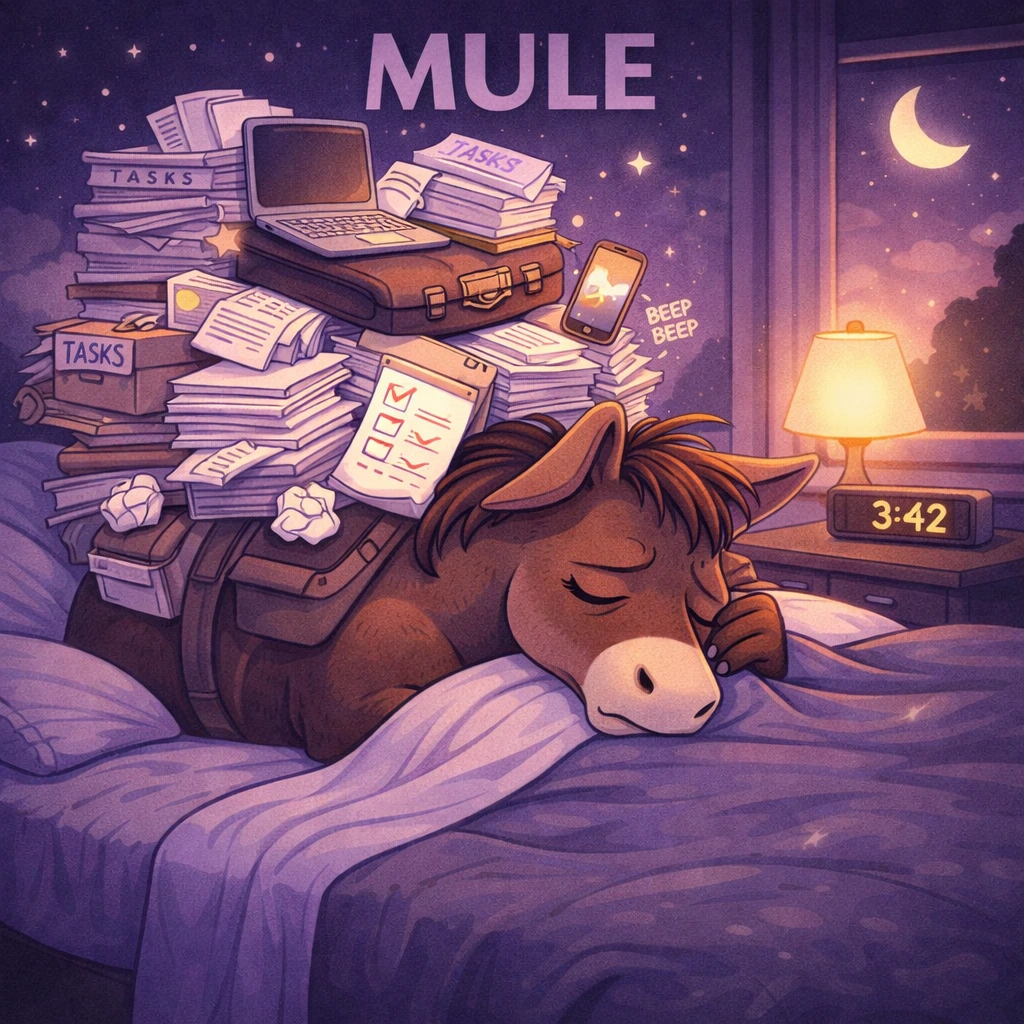
Mule: Heavy-Load Sleeper
You are carrying enough daily load that sleep has become part recovery, part survival.
These animals often can sleep, but are not consistently given enough opportunity to recover because life is overbooked, interrupted, or compressed.
Interpretation
How to read this phenotype
You are carrying enough daily load that sleep has become part recovery, part survival. [1] [2]
Read this phenotype as a recovery squeeze. Many people here are not failing at sleep so much as trying to recover inside windows that are simply too small or too interrupted. That matters because you can normalize feeling under-recovered surprisingly quickly. The more useful question is often how much real sleep opportunity is available and what keeps cutting into it. The night often gets judged too quickly here when the bigger issue is that recovery is being squeezed into windows that are too small. [3] [4] [5]
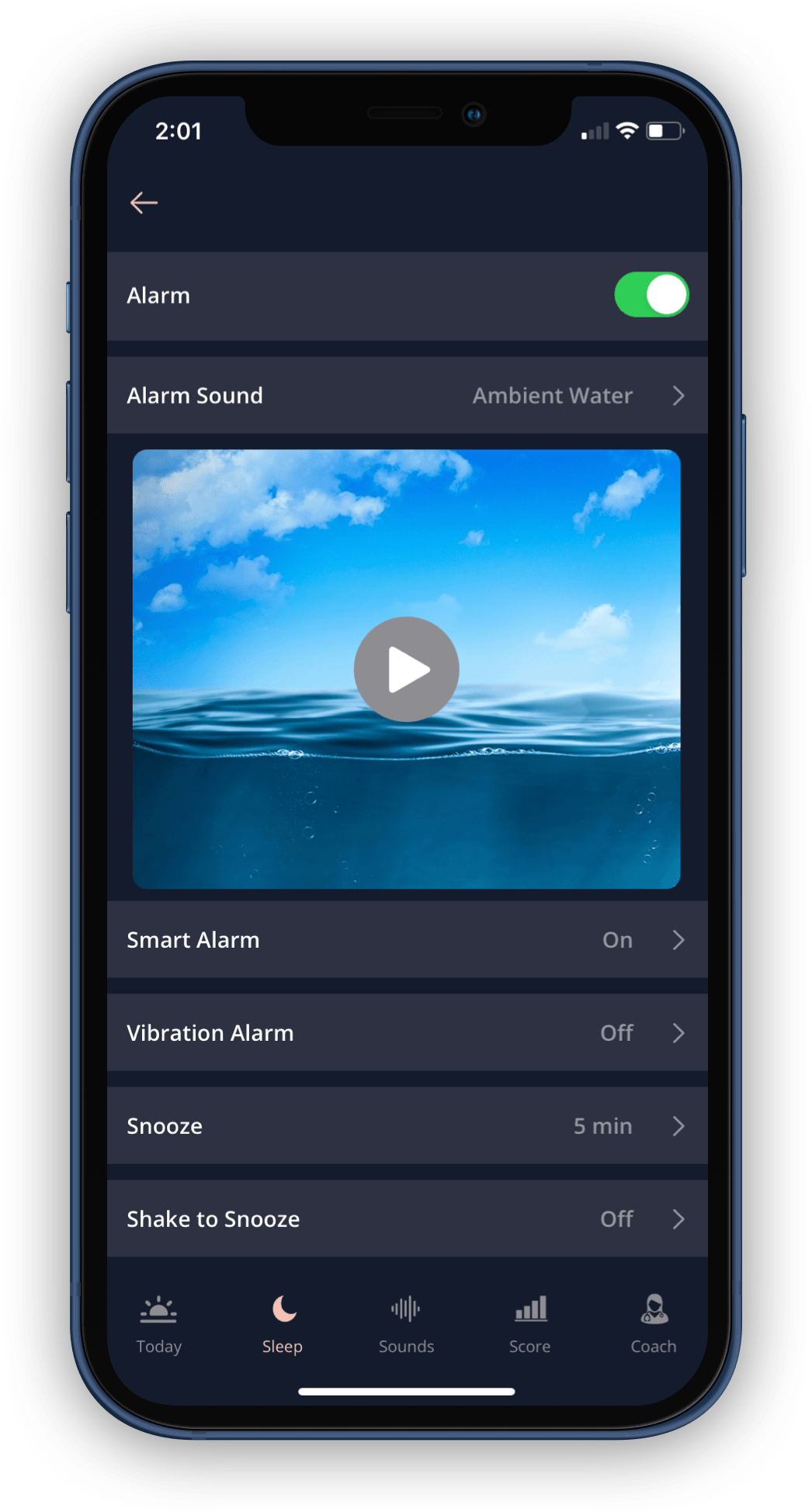
A recurring finding in the sleep-loss literature is that people feel more adapted than their attention, mood, and reaction time really are. That is where SleepSpace becomes more useful than a static score alone: it can help you see the pattern more clearly and, when appropriate, respond in real time with sound and light changes while the night is still unfolding. [6]
What this often looks like
Common signals in real life
- You are carrying enough daily load that sleep has become part recovery, part survival.
- Sleep opportunity is often squeezed by workload, parenting, commuting, or care responsibilities.
- Fatigue can become normalized because the sleeper is highly functional under load.
- Random catch-up sleep rarely feels as good as a more protected baseline schedule.
- The phenotype improves when recovery is scheduled deliberately rather than borrowed.
Why this page exists
What makes Mule distinct
These pages should make it clear that some tired sleepers are not disordered so much as under-recovered.
Focus on reliability over perfection. SleepSpace can help create a more repeatable wind-down and better continuity under real-life load.
Scientific read
The restriction literature is blunt about one thing: people adapt subjectively to sleep loss faster than they recover cognitively. You can get used to being under-recovered and still perform below your own normal. That is why these pages lean so heavily on sleep opportunity. If the window is too small, the first intervention is often protective time rather than another optimization hack. Work-family and schedule-control studies matter here because they show sleep is not only an individual choice problem. Structure and daily load shape the size and quality of the recovery window. This is also where rebound patterns start to make sense. Many people only realize how compressed the routine has been when a free day finally lets the body show what it was missing. [7] [10] [13] [16] [19]
The practical move is to protect recovery time first and then use data to see whether the night itself is also being disrupted. The short-sleep literature is blunt: people can normalize under-recovery faster than they actually recover. Mood, judgment, appetite, and reaction time often keep paying the price quietly. This is the phenotype family where recovery opportunity itself is often the first intervention, not the last thing you try after more complicated hacks. The night often gets judged too quickly here when the bigger issue is that recovery is being squeezed into windows that are too small. [8] [11] [14] [17] [20]
Recovery-focused papers keep showing the same thing: a strong baseline is something to protect before it slips, not chase after it is gone. Actigraphy papers keep showing how much you learn when timing, duration, and fragmentation are tracked over enough nights to reveal the real pattern. A recurring finding in the sleep-loss literature is that people feel more adapted than their attention, mood, and reaction time really are. Small thermal disruptions can keep sleep lighter than the clock would suggest, especially in the second half of the night. [9] [12] [15] [18]
Tracking and wearables
What data often helps separate this pattern from nearby ones
The tracking goal is to expose where recovery is actually being lost. Time in bed, total sleep time, naps, rebound weekends, and variation across high-load versus low-load days usually matter more than intricate stage interpretation. [2] [13]
SleepSpace's own tracking and wearables articles are especially relevant for these pages because they reinforce the difference between a one-night impression and an interpretable pattern. That is useful for every phenotype, but it becomes essential when the mechanism changes with context. [11] [13] [12]

SleepSpace app features
Use these tools if you want to improve this pattern instead of just reading about it
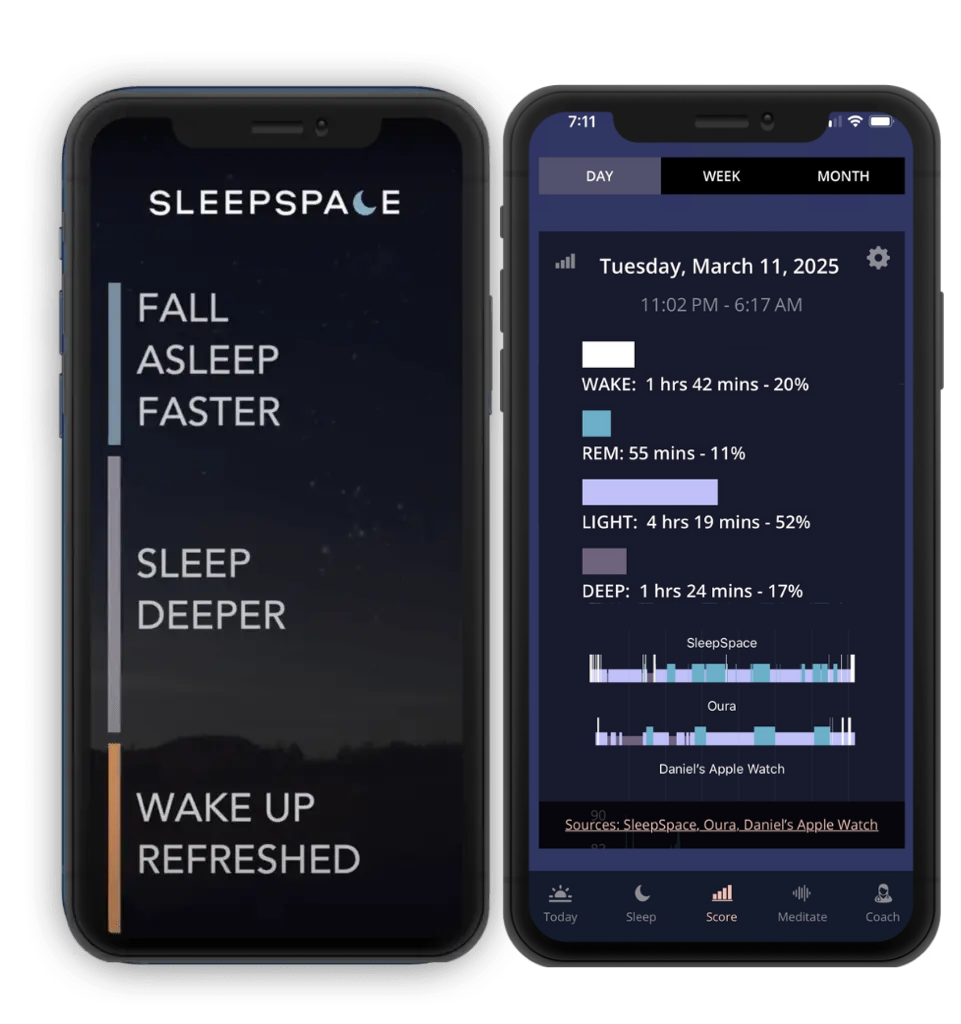
Start with the assessment, download the app, and use the features below to turn this sleep animal into a practical plan.
SleepSpace feature
Sleep assessment
Start here if you want a clearer read on your sleep animal, your main bottlenecks, and what to work on first.
Learn how to use it
SleepSpace feature
Sleep diary
Use the diary to catch patterns in timing, awakenings, stress, recovery, and what actually changed from one night to the next.
Learn how to use it

SleepSpace feature
Weekly sleep stats
Use weekly trends to see whether you are actually improving instead of judging everything from one rough night.
Learn how to use it
SleepSpace resources
SleepSpace resources that fit this phenotype
These were selected by spidering SleepSpace topic pages and product resources that match the mechanism cluster behind this animal.
SleepSpace article
SleepSpace learning hub
A broad SleepSpace article library that can serve as the hub resource on every page.
SleepSpace article
SleepSpace science page
Useful when the page needs a product-adjacent evidence destination.
SleepSpace article
Tracking and wearables guide
Useful for pages that emphasize data quality, sleep diaries, and wearables.
SleepSpace article
SleepSpace Phone system
Useful for pages that talk about integrated tracking, environment control, and bedside sleep technology.
FAQ
Questions Dr. Dan would expect about this animal
Quick answers to the questions people usually ask when this sleep pattern feels familiar.
What does the Mule sleep animal mean?
This profile is less about a single issue and more about cumulative burden. Long days, emotional load, caregiving, work, and low margin can all stack together until sleep feels utilitarian instead of restorative. You need a system that respects the weight you are carrying while still helping recovery improve. This phenotype benefits most from sleep support that lowers effort and adds restoration without asking for perfection. This long-form page treats Mule as a sleep phenotype: a memorable wrapper around a recurring pattern that likely clusters across schedule, physiology, stress load, and next-day restoration. The goal is not to claim a formal diagnosis. The goal is to make the likely mechanism more understandable and the next step more obvious. This is educational guidance to help you recognize the pattern, not a medical diagnosis.
What should you track if this mule pattern sounds like you?
The tracking goal is to expose where recovery is actually being lost. Time in bed, total sleep time, naps, rebound weekends, and variation across high-load versus low-load days usually matter more than intricate stage interpretation. [2] [13] Start with the SleepSpace sleep assessment and then use the app to watch what happens to timing, continuity, symptoms, and next-day recovery over time.
When should you get extra help for mule-style sleep problems?
If this pattern is getting more intense, affecting safety, or leaving you persistently exhausted, treat this page as educational and talk with a doctor or sleep specialist. SleepSpace can help you organize the pattern, but medical concerns still deserve medical care.
Important note
Make recovery sturdier under pressure
The phenotype language is educational and pattern-based. It becomes most useful when paired with trend data, practical experimentation, and medical follow-up when symptoms are severe, persistent, or safety-relevant.
Use SleepSpace to rebuild steadier sleep when your days are heavy and your nights have to do more.
Research references
Selected citations for this page
Show citations (20)
- Ramos et al. (2014). Sleep duration is associated with white matter hyperintensity volume in older adults: the Northern Manhattan Study.
The night often gets judged too quickly here when the bigger issue is that recovery is being squeezed into windows that are too small.
Full article - de Souza et al. (2010). Age-related changes during a paradigm of chronic sleep restriction.
A recurring finding in the sleep-loss literature is that people feel more adapted than their attention, mood, and reaction time really are.
Full article - Tempesta et al. (2010). Lack of sleep affects the evaluation of emotional stimuli.
A recurring finding in the sleep-loss literature is that people feel more adapted than their attention, mood, and reaction time really are.
Full article - Kim et al. (2018). Association between sleep duration and metabolic syndrome: a cross-sectional study.
Strategic naps can restore more than people expect when the alternative is trying to grind through a biologically low period.
Full article - Kaufmann et al. (2016). Clinical significance of mobile health assessed sleep duration and variability in bipolar disorder.
Deep sleep is not just about logging enough hours; it is where the night often becomes truly restorative.
Full article - Shochat et al. (2012). Impact of lifestyle and technology developments on sleep.
This review is useful because the night often gets judged too quickly here when the bigger issue is that recovery is being squeezed into windows that are too small.
Full article - Dawson et al. (2012). Fatigue-proofing: a new approach to reducing fatigue-related risk using the principles of error management.
This review is useful because the night often gets judged too quickly here when the bigger issue is that recovery is being squeezed into windows that are too small.
Full article - Roach et al. (2004). A model to predict work-related fatigue based on hours of work.
Recovery-focused papers keep showing the same thing: a strong baseline is something to protect before it slips, not chase after it is gone.
Full article - Arnedt et al. (2005). Neurobehavioral performance of residents after heavy night call vs after alcohol ingestion.
Recovery-focused papers keep showing the same thing: a strong baseline is something to protect before it slips, not chase after it is gone.
Full article - King et al. (2008). Short sleep duration and incident coronary artery calcification.
Actigraphy papers keep showing how much you learn when timing, duration, and fragmentation are tracked over enough nights to reveal the real pattern.
Full article - Lee et al. (2016). Age differences in workplace intervention effects on employees’ nighttime and daytime sleep.
This trial is especially relevant because actigraphy papers keep showing how much you learn when timing, duration, and fragmentation are tracked over enough nights to reveal the real pattern.
Full article - Sletten et al. (2015). Inter-individual differences in neurobehavioural impairment following sleep restriction are associated with circadian rhythm phase.
A recurring finding in the sleep-loss literature is that people feel more adapted than their attention, mood, and reaction time really are.
Full article - Dawson et al. (2011). Modelling fatigue and the use of fatigue models in work settings.
This review is useful because recovery-focused papers keep showing the same thing: a strong baseline is something to protect before it slips, not chase after it is gone.
Full article - Klingenberg et al. (2012). Short sleep duration and its association with energy metabolism.
Small thermal disruptions can keep sleep lighter than the clock would suggest, especially in the second half of the night.
Full article - Lane et al. (2013). Common variants in CLOCK are not associated with measures of sleep duration in people of european ancestry from the sleep heart health study.
The night often gets judged too quickly here when the bigger issue is that recovery is being squeezed into windows that are too small.
Full article - Ibrahim et al. (2011). Rapid antidepressant changes with sleep deprivation in major depressive disorder are associated with changes in vascular endothelial growth factor (VEGF): A pilot study.
A recurring finding in the sleep-loss literature is that people feel more adapted than their attention, mood, and reaction time really are.
Full article - Ogilvie et al. (2018). Sex and race differences in the association between sleep duration and adiposity: the Bogalusa Heart Study.
Strategic naps can restore more than people expect when the alternative is trying to grind through a biologically low period.
Full article - Anderson et al. (2011). Sleep deprivation lowers inhibition and enhances impulsivity to negative stimuli.
A recurring finding in the sleep-loss literature is that people feel more adapted than their attention, mood, and reaction time really are.
Full article - Leenaars et al. (2012). Spatial reversal learning is robust to total sleep deprivation.
A recurring finding in the sleep-loss literature is that people feel more adapted than their attention, mood, and reaction time really are.
Full article - Åkerstedt et al. (1982). Sleepiness and shift work: Field studies.
The night often gets judged too quickly here when the bigger issue is that recovery is being squeezed into windows that are too small.
Full article
Nearby profiles