
Quantity and Life Constraints pattern
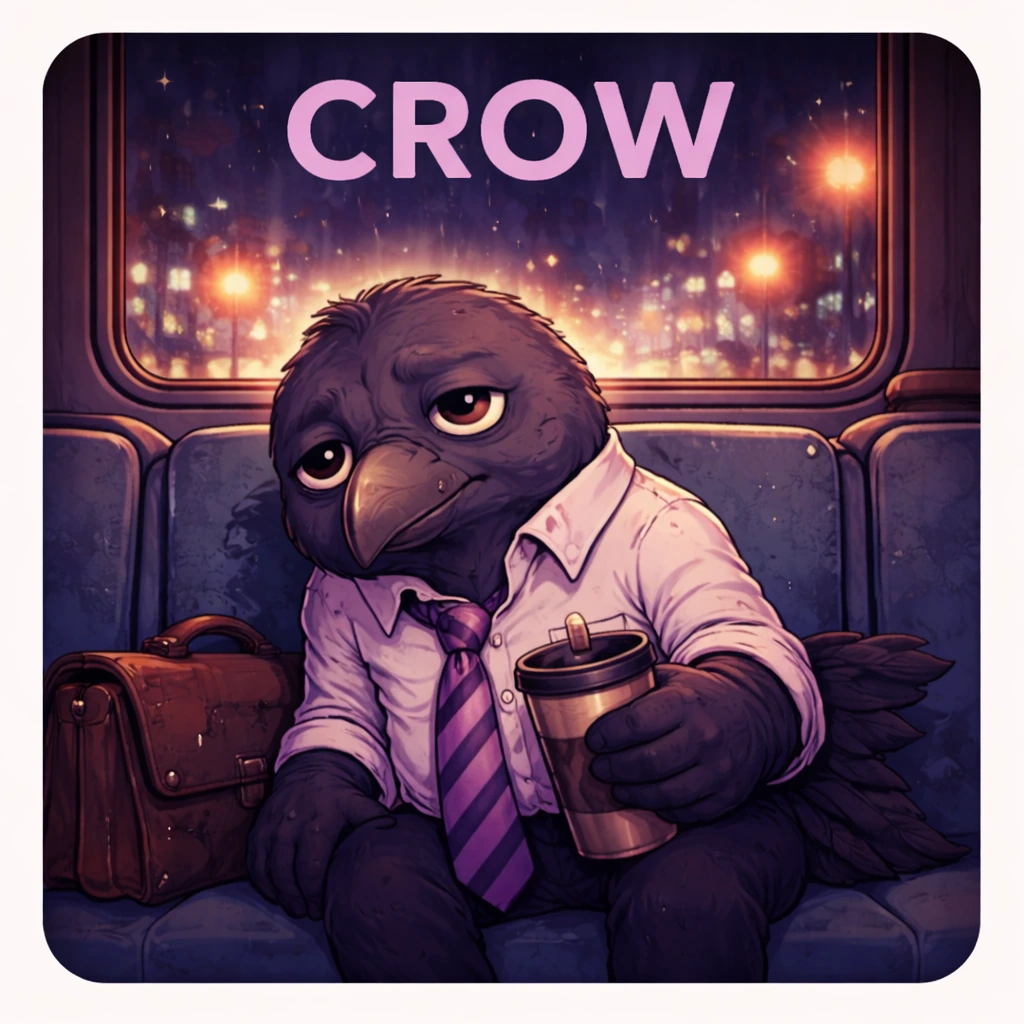
Crow: Long-Commuter Sleeper
Your days may be stealing from your nights.
These animals often can sleep, but are not consistently given enough opportunity to recover because life is overbooked, interrupted, or compressed.


Start here
Turn this into a practical next step
Pick one small action, then check the pattern over several nights. You do not need to solve everything at once.
Interpretation
What this pattern means
Your days may be stealing from your nights. [1] [2]
This pattern is characterized by limited, interrupted recovery time. Many people here are not failing at sleep so much as trying to recover inside windows that are simply too small or too interrupted. That matters because you can normalize feeling under-recovered surprisingly quickly. The more useful question is often how much real sleep opportunity is available and what keeps cutting into it. Feeling used to a short sleep schedule does not always mean attention, mood, and reaction time have recovered. [3] [4] [5]
That is where SleepSpace becomes more useful than a static score alone: it can help you see the pattern more clearly and, when appropriate, respond in real time with sound and light changes while the night is still unfolding. [6]
In real life: A long commute quietly eats the recovery margin at both ends of the day. Look for one reclaimable piece of time—prepacked mornings, fewer late errands, or a shorter evening task list—and give it back to sleep.
What this often looks like
Common signals in real life
- Sleep opportunity is often squeezed by workload, parenting, commuting, or care responsibilities.
- Fatigue can start to feel normal when you stay highly functional under sustained pressure.
- Catch-up sleep can help, but it rarely replaces a regular baseline schedule.
- The pattern often improves when recovery time is protected in advance.
Why this page exists
What makes Crow distinct
These pages should make it clear that some tired sleepers are not disordered so much as under-recovered.
Find one or two points in the day where recovery can be protected. SleepSpace can help make your nights more efficient and your schedule more sleep-supportive.
Scientific read
The restriction literature is blunt about one thing: people adapt subjectively to sleep loss faster than they recover cognitively. You can get used to being under-recovered and still perform below your own normal. That is why these pages lean so heavily on sleep opportunity. If the window is too small, the first next step is often protective time rather than another optimization hack. Work-family and schedule-control studies matter here because they show sleep is not only an individual choice problem. Structure and daily load shape the size and quality of the recovery window. This is also where rebound patterns start to make sense. Many people only realize how compressed the routine has been when a free day finally lets the body show what it was missing. [7] [10] [13]
The practical move is to protect recovery time first and then use data to see whether the night itself is also being disrupted. People can get used to feeling under-recovered before their attention and reaction time have fully recovered. Mood, judgment, appetite, and reaction time often keep paying the price quietly. This is the pattern family where recovery opportunity itself is often the first next step, not the last thing you try after more complicated hacks. Feeling used to a short sleep schedule does not always mean attention, mood, and reaction time have recovered. [8] [11] [14]
The night often gets judged too quickly here when the bigger issue is that recovery is being squeezed into windows that are too small. Strategic naps can restore more than people expect when the alternative is trying to grind through a biologically low period. The restriction literature is blunt about one thing: people adapt subjectively to sleep loss faster than they recover cognitively. You can get used to being under-recovered and still perform below your own normal. That is why these pages lean so heavily on sleep opportunity. If the window is too small, the first next step is often protective time rather than another optimization hack. [9] [12] [15]
Tracking and wearables
What data often helps separate this pattern from nearby ones
The tracking goal is to expose where recovery is actually being lost. Time in bed, total sleep time, naps, rebound weekends, and variation across high-load versus low-load days usually matter more than intricate stage interpretation. [2] [13]
Compare sleep opportunity, total sleep, naps, and rebound sleep across busy and lighter days. The goal is to see whether recovery time is consistently too small. [11] [13] [12]
SleepSpace app features
Use these tools if you want to improve this pattern instead of just reading about it
Start with the assessment, download the app, and use the features below to turn this sleep animal into a practical plan.

SleepSpace feature
Sleep assessment
Start here if you want a clearer read on your sleep animal, your main bottlenecks, and what to work on first.
Learn how to use it
SleepSpace feature
Sleep diary
Use the diary to catch patterns in timing, awakenings, stress, recovery, and what actually changed from one night to the next.
Learn how to use it

SleepSpace feature
Weekly sleep stats
Use weekly trends to see whether you are actually improving instead of judging everything from one rough night.
Learn how to use it
SleepSpace resources
SleepSpace resources that fit this pattern
Use these practical guides and tools to understand this sleep pattern and choose a useful next step.
SleepSpace article
SleepSpace learning hub
A broad SleepSpace article library that can serve as the hub resource on every page.
SleepSpace article
SleepSpace science page
Useful when the page needs a product-adjacent evidence destination.
SleepSpace article
Tracking and wearables guide
Useful for pages that emphasize data quality, sleep diaries, and wearables.
SleepSpace article
SleepSpace Phone system
Useful for pages that talk about integrated tracking, environment control, and bedside sleep technology.
FAQ
Questions Dr. Dan would expect about this animal
Quick answers to the questions people usually ask when this sleep pattern feels familiar.
What does the Crow sleep animal mean?
When commute time gets long, sleep is often the first thing that gets compressed. Even a decent routine can become hard to sustain when your schedule is stretched at both ends. This pattern often creates a steady, low-grade sleep debt that feels normal until it is not. Reclaiming even a small amount of sleep time can create a surprisingly large improvement. For this pattern, minutes matter because the schedule is already running with very little margin. Sleep can be shaped by schedule, stress load, sleep environment, body signals, and what happens the following day. Looking for repeatable changes across several nights makes it easier to identify a useful next step.
What should you track if this crow pattern sounds like you?
The tracking goal is to expose where recovery is actually being lost. Time in bed, total sleep time, naps, rebound weekends, and variation across high-load versus low-load days usually matter more than intricate stage interpretation. [2] [13] Start with the SleepSpace sleep assessment and then use the app to watch what happens to timing, continuity, symptoms, and next-day recovery over time.
When should you get extra help for crow-style sleep problems?
If this pattern is getting more intense, affecting safety, or leaving you persistently exhausted, treat this page as educational and talk with a doctor or sleep specialist. SleepSpace can help you organize the pattern, but medical concerns still deserve medical care.
Important note
Steal back recovery from a long day
The pattern language is educational and pattern-based. It becomes most useful when paired with trend data, practical experimentation, and medical follow-up when symptoms are severe, persistent, or safety-relevant.
SleepSpace helps make limited sleep windows more restorative and easier to protect.
Research references
Research behind these sleep insights
Show citations (15)
- Ratcliff et al. (2011). Diffusion model for one-choice reaction-time tasks and the cognitive effects of sleep deprivation.
This trial is especially relevant because a recurring finding in the sleep-loss literature is that people feel more adapted than their attention, mood, and reaction time really are.
Full article - Wilkinson et al. (1968). Sleep deprivation.
This trial is especially relevant because a recurring finding in the sleep-loss literature is that people feel more adapted than their attention, mood, and reaction time really are.
Full article - Lieberman et al. (2006). Cognition during sustained operations: comparison of a laboratory simulation to field studies.
This trial is especially relevant because a recurring finding in the sleep-loss literature is that people feel more adapted than their attention, mood, and reaction time really are.
Full article - Spinweber et al. (1976). Long and short sleepers: Male and female subjects.
Deep sleep is not just about logging enough hours; it is where the night often becomes truly restorative.
Full article - Centers for Disease Control and Prevention et al. (2012). Short sleep duration among workers -- United States, 2010.
The night often gets judged too quickly here when the bigger issue is that recovery is being squeezed into windows that are too small.
Full article - Grandner et al. (2010). Problems associated with short sleep: bridging the gap between laboratory and epidemiological studies.
This review is useful because a recurring finding in the sleep-loss literature is that people feel more adapted than their attention, mood, and reaction time really are.
Full article - Krueger et al. (2003). Sleep function.
Feeling used to a short sleep schedule does not always mean attention, mood, and reaction time have recovered.
Full article - Kripke et al. (2000). Response.
This trial is especially relevant because a recurring finding in the sleep-loss literature is that people feel more adapted than their attention, mood, and reaction time really are.
Full article - Ohlmann et al. (2009). The costs of short sleep.
The night often gets judged too quickly here when the bigger issue is that recovery is being squeezed into windows that are too small.
Full article - Yao et al. (2018). Healthy behaviors competing for time: associations of sleep and exercise in working Americans.
Strategic naps can restore more than people expect when the alternative is trying to grind through a biologically low period.
Full article - Jung et al. (2011). Comparison of sustained attention assessed by auditory and visual psychomotor vigilance tasks prior to and during sleep deprivation.
This trial is especially relevant because a recurring finding in the sleep-loss literature is that people feel more adapted than their attention, mood, and reaction time really are.
Full article - Harrison et al. (2000). The impact of sleep deprivation on decision making: A review.
This trial is especially relevant because a recurring finding in the sleep-loss literature is that people feel more adapted than their attention, mood, and reaction time really are.
Full article - Folkard et al. (1984). Is there more than one circadian clock in humans? Evidence from fractional desynchronization studies.
This trial is especially relevant because a recurring finding in the sleep-loss literature is that people feel more adapted than their attention, mood, and reaction time really are.
Full article - Watson et al. (2005). Impact of the ACGME work hour requirements: a neurology resident and program director survey.
This trial is especially relevant because a recurring finding in the sleep-loss literature is that people feel more adapted than their attention, mood, and reaction time really are.
Full article - Basner et al. (2011). Maximizing sensitivity of the psychomotor vigilance test (PVT) to sleep loss.
This review is useful because a recurring finding in the sleep-loss literature is that people feel more adapted than their attention, mood, and reaction time really are.
Full article
Nearby profiles
Other animals in the same neighborhood

Related animal
Camel
Sleep Debt Carrier
You have become good at functioning on less sleep than your body actually wants.
Related animal
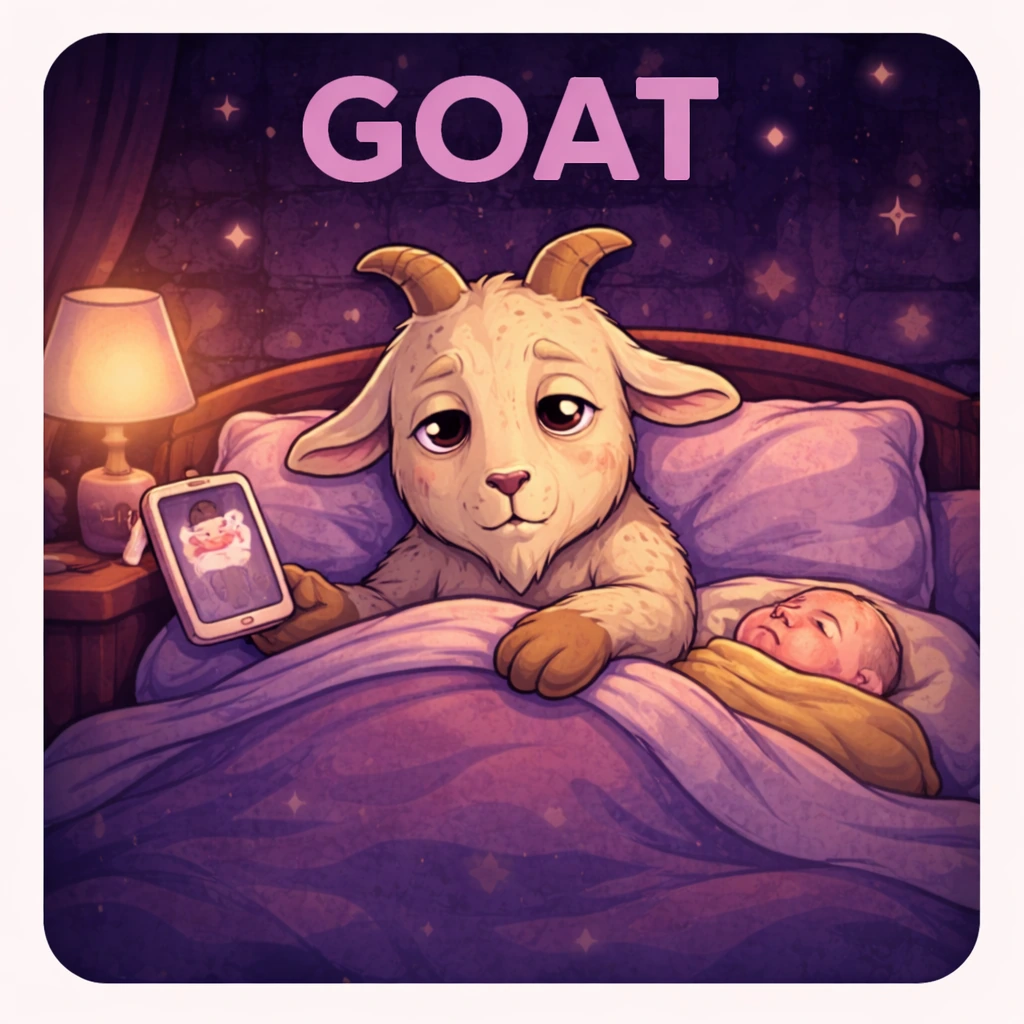
Goat
Caregiver Sleeper
Your sleep is carrying more than your own needs.
Related animal
Kangaroo
New Parent Sleeper
Your sleep is being asked to stay protective, flexible, and interrupted all at once.