
The Circadian Rhythm
The 24 Hour Cycle That Dictates Energy Levels
By Dr. Dan Gartenberg
Last Updated: July 11, 2026
Overview of the Circadian in Humans
Every living animal has a circadian rhythm in one fashion or another. In humans, the circadian rhythm is a 24 hour cycle that dictates when you are most alert and when you are ready for sleep. A typical circadian rhythm in humans is one where peak alertness is around 2-3 hours after awakening and 9-10 hours after awakening, and where fatigue is most likely at around 3 AM, if you wake up like most people do at around 7-9 AM in the morning. However, this rhythm is impacted by many factors and it can be shifted. A major takeaway is that a healthy circadian rhythm can get you a deeper night of sleep, where the most important thing is regularity. Everyone can get deep, more regenerative, sleep when they give their body the cues it needs when it needs it. SleepSpace seamlessly measures your circadian rhythm by integrating with the consensus sleep diary, various wearables, and the SleepSpace Smart Bed. We then give you alerts about your morning peak, afternoon dip, and second wind using our proprietary circadian optimizer technology.
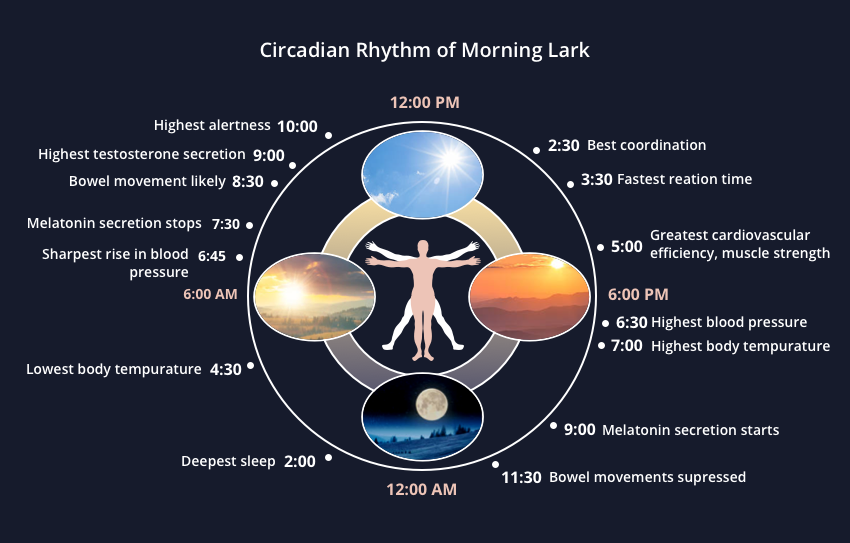
The circadian rhythm acts as each person’s internal clock. It operates in humans on a 24-hour cycle and affects various biological processes throughout the day, such as sleepiness, peak exercise potential, body temperature, and blood pressure. Many people find themselves particularly tired at around 2am to 4am, and drowsy in the hours after lunch, at around 2pm to 4pm. Many also experience periods of peak alertness, usually occurring between 9am to 11am and 7pm to 9pm. These cyclical periods of sleepiness and alertness are due to the circadian rhythm. Humans have an overall circadian rhythm and then each organ actually has its own rhythm as well, which operates within the overarching circadian rhythm.
While the general timeline of the circadian rhythm is similar for most people, there can be significant variation in each individual’s circadian component. It is possible to change your circadian rhythm through a few different mechanisms, like consistently changing your bedtime and wake time, exposure to sunlight, relaxation exercises, and temperature changes. When your bedtime and wake-up time is consistently later than average, then your circadian rhythm is shifted to later hours. In other words, instead of becoming tired at 10pm, a person with late sleep patterns might not become tired until 1 in the morning.
Perhaps you have a goal to wake later or fall asleep earlier, then you can take steps to shift your circadian rhythm to meet this goal, which we outline below. It can be difficult to adjust sleep schedules because the circadian rhythm affects tiredness levels. If you are naturally tired in the early morning hours and fall asleep at 2am, it will be frustrating and likely futile to try to sleep at 10pm. Instead, try moving your bedtime back by 20-30 minutes gradually. As your circadian rhythm adjusts to your new bedtime and wake-time, you will find yourself becoming sleepy at the time you desire. Similarly, slowly adjusting your wake time can be more effective than a sudden shift. When wake times and bedtimes are consistent, your circadian rhythm will help you fall asleep and wake up more easily, as you will feel tired before bed and alert as you wake up.
How the Circadian Rhythm Impacts Alertness
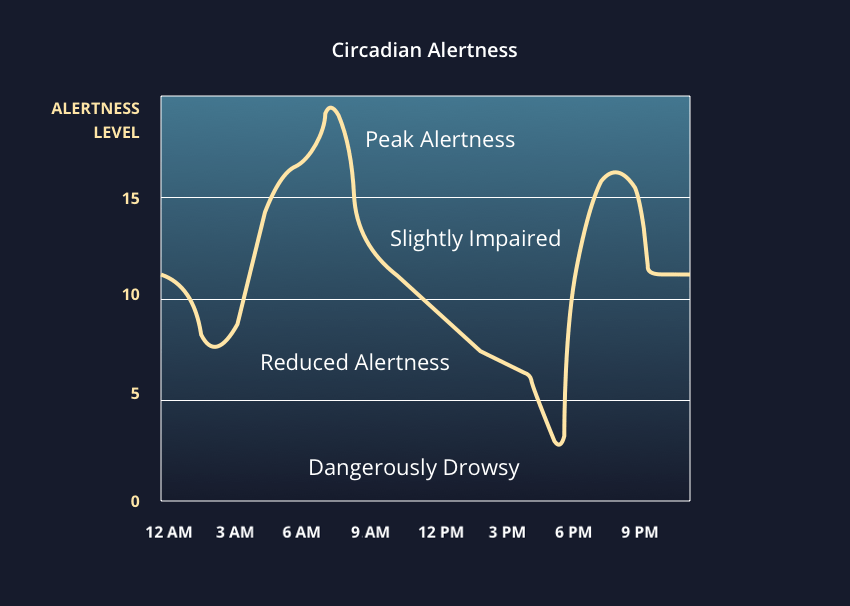
Your body has two main processes that dictate your alertness, how long you have been awake, called your homeostatic sleep drive, which is largely impacted by deep sleep, and the 24-hour circadian rhythm. These two processes, combine to form the two process model of sleep and a typical energy level like what is articulated in the above graph. Notice how there are peaks and valleys and the overall reduction in alertness until bedtime. If you are a morning lark, this rhythm will be shifted earlier in the day, whereas if you are a night owl it will be shifted later.
Light Exposure and the Circadian Rhythm
Circadian components are affected by sleep schedules, but they are also affected by your environment, particularly, exposure to sunlight, but also when you eat, exercise, and even when you socialize. These external cues are known as “Zeitgebers” or time keepers (see video overview below). When your body is exposed to sunshine, it causes a chemical reaction through photoreceptors in your eyes that send a signal to your suprachiasmatic nucleus that makes your body feel more alert. By opening your blinds and turning on the lights as soon as you wake up, you will shake off morning grogginess more quickly than if you leave the blinds closed. Another hack if you want to counteract morning grogginess - try splashing some cold water on your face to start revving up your core body temperature.
The other side of light exposure is that it often takes longer to fall asleep if you have just been exposed to bright light close to bedtime (especially blue light). By adjusting light exposure, you can help your body to feel alert or sleepy, depending on if you want to wake up or fall asleep. Getting blackout blinds is one of the best solutions to start controlling your light exposure. Also limit sunglass usage during the day to ensure you get the light you need to set your rhythm. If you wake up before the sun rises, or live in a place without much sunlight, using a sunlamp to imitate the sun’s rays can be an effective tool to help combat sleepiness, without needing to use caffeine. However, getting direct sun exposure, not through a window, but directly outside is probably the best way to entrench a healthier circadian rhythm. This will also help you fall asleep, stay asleep, and get a deeper night.
Napping, Caffeine, and Exercise Based on the Circadian Rhythm
Napping during the day can help to alleviate the mid-day sleepiness that comes with the circadian rhythm. Short naps of 20-30 minutes during periods of tiredness can help keep you focused and alert throughout the day. Alternatively, drinking caffeine can also help you counteract that afternoon dip. For the best effect with caffeine in terms of addressing that afternoon dip, try not to drink it right in the morning, but around 60-90 minutes after you wake up. Then try to stop drinking caffeine at around 2 pm - 3 pm (based on a typical sleep schedule of waking up between 7-9 am. Also, some people just don't like taking naps, and that can be perfectly healthy as well. There are a few different styles of sleeping that can lead to a healthy circadian rhythm, many of which are impacted by societal pressures and responsibilities. By tracking your own periods of peak alertness and sleepiness, you can ascertain your own personal circadian rhythm. There are even genetic tests you can take that tell you if you have genes that make you more likely to be a morning lark, night owl, or as we call it, a flexible octopus.
Take our sleep quiz to discover your sleep animal. Knowing your unique energy rhythm means that you can better schedule your daily activities. If you always feel tired at 4pm, then you can schedule a run or a nap before this period to help reduce your feelings of tiredness. If you are at your most alert at 10am, then scheduling important meetings at this time can ensure that you will be alert and at you best. Generally, most people find that it is better to do analytical work in the morning and more creative work in the late afternoon or night.
Chronobiology
Some people are morning people or ‘larks’ – others are evening people or ‘owls.’ This tendency to have a peak alertness either earlier or later in the day is known as chronobiology. Your unique chronobiology is influenced by your genetic makeup and environmental cues called zeitgebers. About 25% of the population are larks, 10% are night owls, and the rest of us are shiftable, with a circadian rhythm that can be shifted by external cues that you give to your body. Everyone can shift their circadian rhythm to some degree with these zeitgebers. The evolutionary basis for this relates to always ensuring that a member of the tribe is awake to protect the camp. Unfortunately our modern society was forged out of industrialism in a way that is unjustly preferential towards early rises, with strict morning work times.
For an in-depth understanding of chronobiology and sleep inertia check out an interview Dr. Daniel Gartenberg gave to Quartz entitled “Why eight hours a night isn’t enough, according to a leading sleep scientist.”
Zeitgebers: Time Givers
Thankfully, we can impact the expression of our genes through our environment in order to create a healthier circadian rhythm. Zeitgebers are environmental cues like sunlight, exercise, and eating that impact your circadian rhythm and energy levels throughout the day. Temperature and even social interactions can also create environmental cues that tell your body when to be alert. These external cues reset the internal body clock, also known as your circadian rhythm. Naturally occurring sunlight is the strongest zeitgeber because of its impact on hormones like melatonin. Even when our eyes are closed, photoreceptors in the eye can detect sunlight. These photoreceptors respond to sunlight by inhibiting melatonin. Due to the fact that we have become indoor creatures, people are often out of touch with their circadian rhythm. This happens when you do not entrench your zeitgebers within your daily schedule.
Try to do the following things at a similar time every day:
-
• Sunlight in the morning when you wake up
• Similar bedtimes and wake times
• Eat at consistent times in the day and not too close to night. If you want to be a morning lark, eat and exercise more in the morning, if you want to be a night owl, shift these behaviors to be more in the later part of the day
• Exercise at the same time every day
• Raise your body temperature during the day, either with cardiovascular exercise or a sauna
• Stimulate yourself with social interactions at the same time every day
10-Top Tips for Promoting a Healthy Circadian Rhythm
-
1) Avoid social jetlag.
A major cause of irregular sleep schedules is when people go out on the weekend, but wake up early for work on weekdays. In sleep science, this is known as ‘social jetlag.’ Generally speaking, there are two main solutions: 1) Try not to go out too late on the weekends; or 2) Work with your employer on a later start-time and end-time for work. If going out late at night is very important to you, here is a simple hack. Make Friday night your late night so your body has more time to adjust to an earlier wakeup later in the weekend. -
2) Set a sleep schedule.
Everyone should have an ideal bedtime and wake-time goal that you strive to be consistent with. This goal should take into account your sleep need, which is another essential factor for healthy sleep. Typically, sleep need should be prioritized above consistency. For example, if you have a very late night, it’s probably better to sleep in that next day than to wake up earlier and be consistent with your wake up times. You can simply use your iPhone or Android clock alarm to set a morning wake up time goal, or take it to the next level by downloading an app like SleepSpace. SleepSpace will continuously notify you to awaken until you open the app and uses sound and light to reduce morning brain fog. -
3) Use Zeitgebers to entrench your rhythm.
Zeitgeber comes from the German word “Zeit”, which means “time” and “geber,” which means giver. In sleep science, this refers to external cues that can entrench your circadian rhythm. In other words, you can shift or strengthen your circadian rhythm when you align certain external cues with your goals. The Zeitgeber that has the largest influence on your circadian rhythm is natural sunlight, but other factors include the timing of meals, exercise, and even when you socialize. For example, if you want to shift to being more of a morning person, getting sunlight as early as possible can help with this process. Many people also engage in intermittent fasting nowadays. However, if you are trying to be a morning person and fast during the morning, this sends the wrong cue for healthy circadian alignment. Morning people will often be better off expending and consuming energy in the morning. Whereas, evening people will be better off doing so in the evening. -
4) Don’t adjust too quickly.
The most important thing for circadian health is consistency. There is a misconception that night owls are less healthy, but this has more to do with societal pressures to awaken early and therefore get less sleep. Therefore, night owls should feel liberated in being themselves when they can, but this is not always possible due to pressures at work. While some people have a very fixed circadian rhythm, we can all shift it to some degree with the right cues, or “zeitgebers.” However, when you are shifting your rhythm, it is difficult for the body to do so abruptly. Try to go to bed and wake up only about a half hour later or earlier each night when shifting your rhythm. -
5) Make your bedroom a sleep sanctuary.
One of the easiest ways to consistently fall asleep and wake up at your bedtime and wakeup goal is to save your bed for sleep and sex only. You should not be doing work, looking at your phone, or doing much of anything else in your bedroom. It should be a quite, dark, cool and comfortable place with sheets that have optimal comfort and breathability (i.e. Ettitude bedding). In sleep science, this is known as stimulus control. Humans are association machines. When we do things like work in the bedroom, the bedroom becomes a place where we get activated, when it should be a place of tranquility. -
6) Write your superintendent or congressperson to implement later start times for high school.
It’s natural for our circadian rhythm to shift throughout our lives. In our teenage years, it naturally shifts to typically be later. An explanation for this that comes from evolutionary biology is that this is by design to help the teenager break away from their parents. Misaligning circadian rhythms with mom and dad helps you become more independent. Yet school often starts earlier for teenagers than younger children who naturally have a morning lark circadian rhythms. This often causes a phenomenon known as, “Delayed Sleep Phase Syndrome” in teenagers. So ask your elected official to flip this around, such that teenagers start school later and younger children start school earlier. -
7) Use smart light to entrench your rhythms.
Since sunlight has the biggest effect on entraining a healthy circadian rhythm, controlling the light in your home is therefore very important. As part of your wind down ritual, which should begin 1 hour to 30 minutes before sleep, it is recommended to reduce blue light as much as possible, and instead, get exposed to red hued light. Blue light will reduce the production of melatonin at night, which will inhibit the ability to fall asleep. In a study that we conducted with LIFX smart bulbs, the simple act of setting their lights to red at night and ramping them up brightly in the morning improved perceived sleep quality on a validated survey. -
8) Be aware of your circadian rhythm.
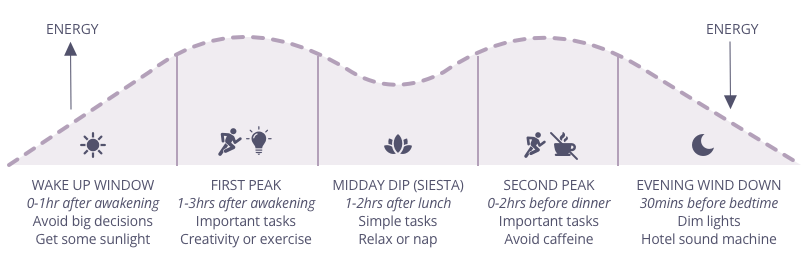
Everyone has a unique circadian rhythm that often becomes weaker as we age due to chronic stress and other factors. Simply being aware of this rhythm can help you navigate regular bedtime and wake times. A typical rhythm involves peak alertness around 2 hours after awakening, a dip during your afternoon siesta, another peak of alertness before dinner, and then gradually reducing alertness until it troughs, usually at around 3 PM for most people (thought his can shift based on whether you are a night owl or a morning lark). Having this awareness of where you are at in your circadian rhythm and when you are tired or most alert can help you better adjust your rhythms. -
9) Drink caffeine, but taper it and not too late.
Caffeine can actually be helpful to entrain a circadian rhythm, but the downside of caffeine is that is has a long half-life (4-8 hours). Therefore it can be in your system still if you drink it much after 12 noon. This can keep you up at night, hinder your sleep quality, even if you are not consciously aware of it, and dysregulate your schedule. However, caffeine can also be helpful in keeping you up and alert when you want to be and it’s an antioxidant that has other healthy effects. Therefore, caffeine can be a useful supplement, but it should be used wisely for best effect. Its therefore suggested to switch to decaf after 12 noon. It is also very easy to build a tolerance to caffeine where you need more and more. To mitigate this, a good hack is to swap in decaf for a few days every month. This will result in a more effective dose of caffeine, without the negative effects of taking too much caffeine. -
10) No scrolling at bedtime.
Not only will scrolling at bedtime expose you to excess blue light, it will also activate your brain and produce cortisol at a time when you should be relaxing. The addictive nature of the phone makes it a larger hinderance to a regulated bedtime than something like TV because if its highly engaging and dopamine fueled in nature. One solution is to set your phone to turn into airplane mode or place it on a charger that is out of reach, which can be accomplished with the SleepSpace Smart Bed.
Body clock and daily energy
Circadian rhythm is more than bedtime and wake time
Your circadian rhythm shapes why you may feel alert late at night, why mornings can feel hard, why weekends sometimes go better than weekdays, and why your energy dips at the wrong times. The 24-hour timing system becomes much more useful when you connect it to light, wake time, daily routine, and what your sleep actually looks like across a week.
A healthy circadian rhythm helps coordinate sleepiness, alertness, hormone timing, body temperature, appetite, and next-day performance. That is why the body clock conversation belongs in any real discussion of insomnia, shift work, social jet lag, travel, or chronic low-energy mornings. [1] [8]
The key idea is not that everyone should force the same schedule. The key idea is that your timing system works best when it gets clear signals. Light is the strongest zeitgeber, but wake time, meal timing, movement, naps, and evening habits all matter too. [4] [8] [12]
That is also why this topic pairs naturally with keeping a regular sleep schedule, the SleepSpace circadian sleep schedule guide, and the zeitgebers overview. Those pages help turn chronobiology into something you can actually use.
Reading the pattern
A circadian rhythm chart matters most when you compare it with the way your week actually unfolds

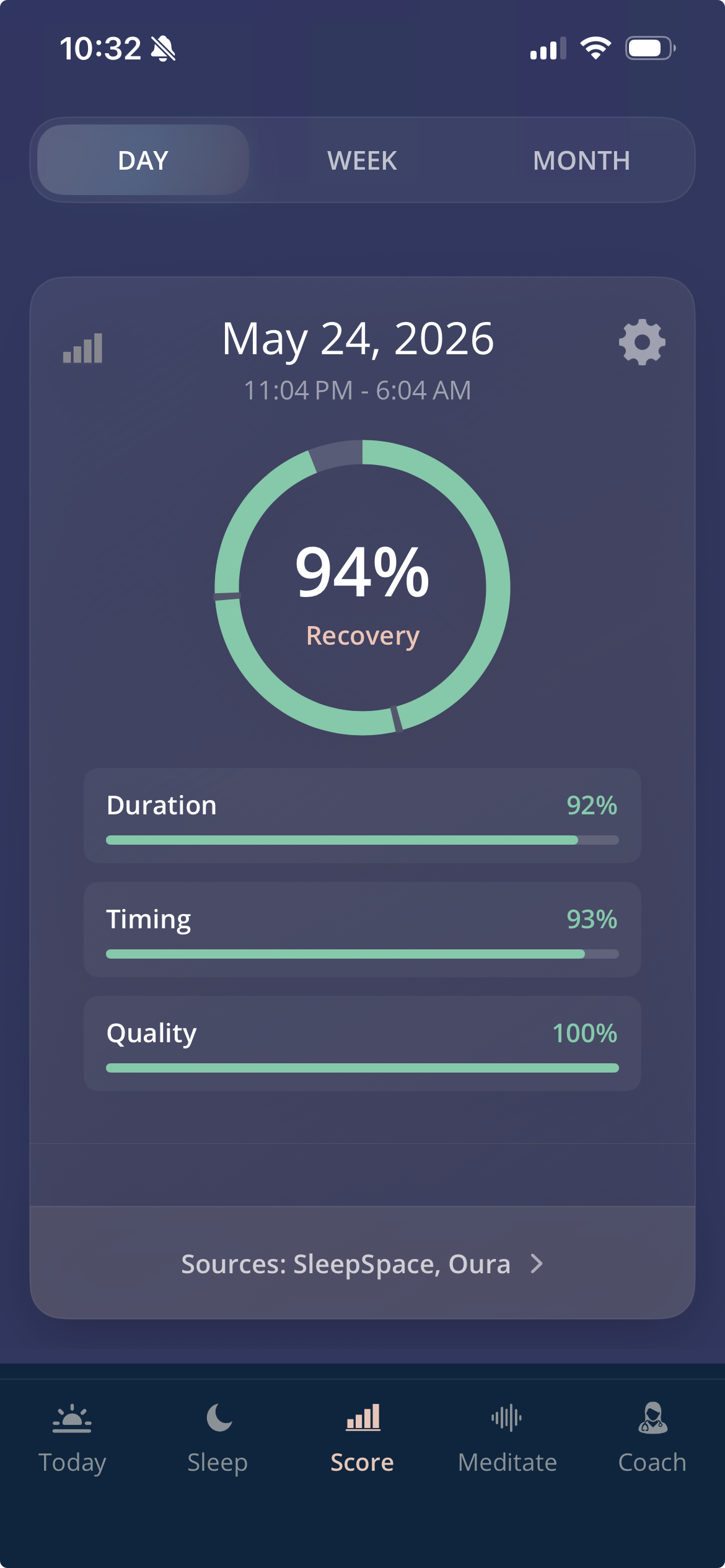
What to look for on the chart
- Whether your best alertness window happens much later than your work or school schedule expects.
- Whether your afternoon dip is being made worse by poor sleep, heavy meals, or mistimed naps.
- Whether your bedtime is arriving before real sleepiness does, which often creates frustration in bed.
- Whether your energy pattern looks different after consistent mornings versus weekends or travel.
How to use the chart
Use the chart to read the body-clock pattern, make better timing decisions, and tell whether the issue is light timing, schedule drift, delayed timing, or simple sleep debt. [1] [7]
Weekend drift
Social jet lag is one of the most common ways to weaken a circadian rhythm
Social jet lag happens when your schedule shifts so much between workdays and free days that Monday starts to feel like a short eastbound flight. You may sleep later, wake later, eat later, and use more light at night on the weekend, then expect your body clock to snap back instantly on Sunday night. [2] [3] [11]
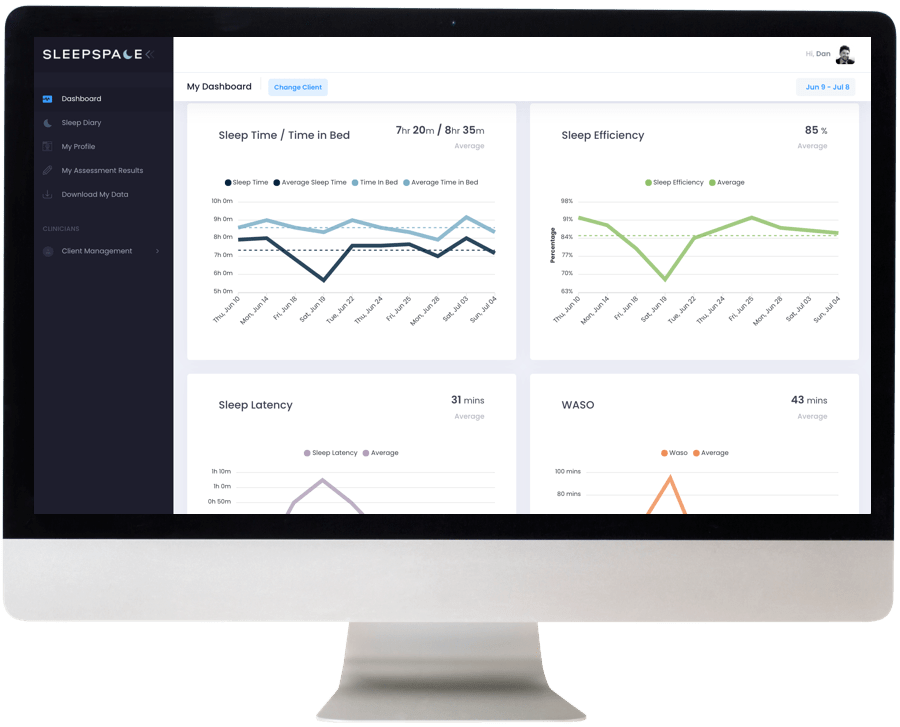
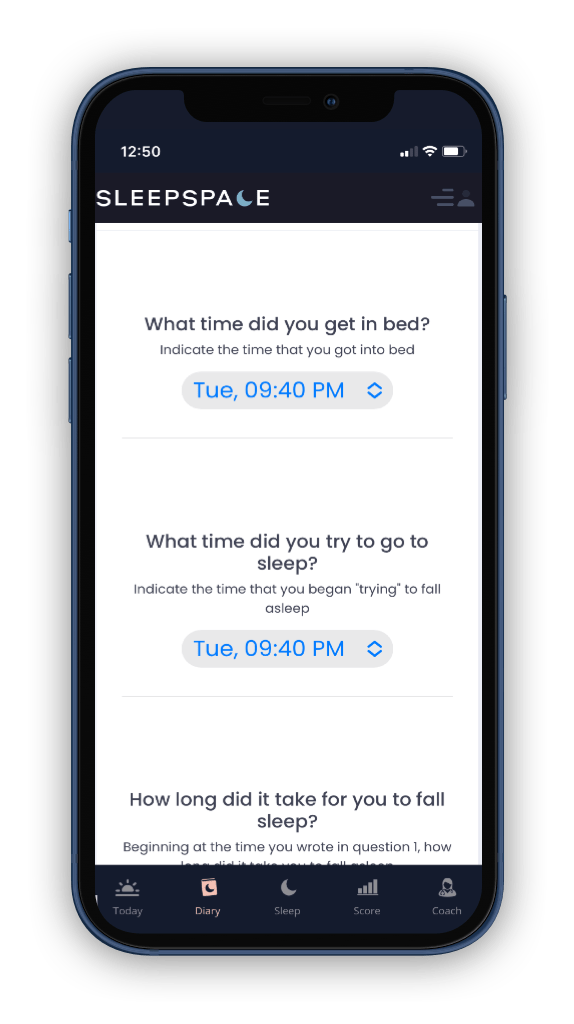
This is where a digital sleep diary becomes especially useful. You usually do not see the full pattern until you can look at bedtimes, wake times, naps, late light exposure, and rough mornings across several days instead of judging each night in isolation. [6]
If this is your pattern, read Keeping a Regular Sleep Schedule. If your life involves rotating hours, early starts, or overnight work, the shift work sleep disorder guide is often the more relevant fit.
Reset strategy
How to reset circadian rhythm without making the plan harsher than it needs to be
1. Protect wake time first
In practice, wake time is usually the stronger anchor. It stabilizes morning light exposure, improves the odds of getting hungry and active on time, and makes the next night easier to align. [1] [4]
2. Use morning light on purpose
Morning light is one of the clearest signals you can give the circadian system. Bright late-evening light can push the clock later, while strong morning light helps pull it earlier and reinforce the day-night contrast. [5] [8]
3. Keep late naps and caffeine from stealing tomorrow
Naps, caffeine, and exercise all interact with the body clock and sleep drive. The question is not only whether they are good or bad. The question is whether they are helping the rhythm or fighting it at the wrong time. [8] [12]
4. Shift gradually if you are a night owl
A delayed schedule usually responds better to precise, repeated cues than to sudden heroic resets. If you are dealing with true delayed timing, gradual wake-time change, well-timed light, and schedule support tend to work better than simply forcing an early bedtime. [9] [10]
If you want a deeper walkthrough of this process inside the app, the SleepSpace schedule guide and the circadian optimizer page are the best internal next steps.
Tracking the right signals
Weekly timing trends are more useful than overreacting to one rough night
Circadian issues usually reveal themselves through repeated timing patterns: late sleep onset, weekend drift, early meetings that cut sleep short, afternoon crashes, or mornings that feel much worse after brighter nights. That is why the best tracking loop combines subjective and objective context instead of turning the body clock into a guessing game. [1] [6] [7]
The SleepSpace consensus sleep diary is especially valuable here because it captures how the night actually felt. If you also use wearables or other connected devices, SleepSpace can put those streams next to timing, diary data, and the Sleep Score instead of forcing you to interpret each source alone. [6]
If you do not use a wearable, the diary still matters. Subjective sleep is not a fallback. It is part of the circadian story, especially for insomnia, delayed timing, and schedule mismatch.
Putting timing in context
Reviewing the right sleep session matters when you are trying to understand circadian patterns
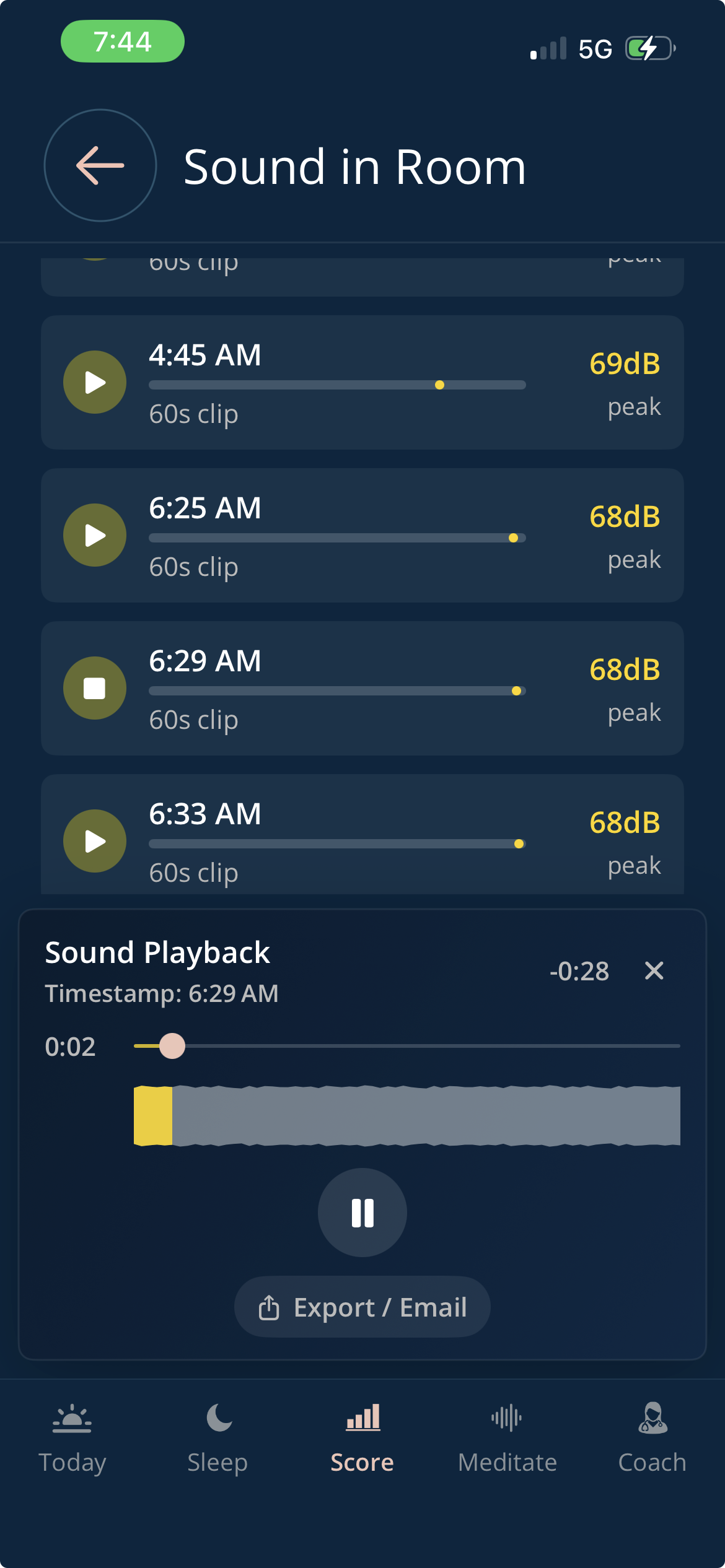
Circadian interpretation gets messy when the night is attached to the wrong day. People with delayed bedtimes often cross midnight before sleep starts, so the meaningful question is not the calendar date on the phone. The meaningful question is which sleep session the data belongs to.
That is why SleepSpace's newer timing and review workflow is helpful for circadian use. Score review, weekly analysis, and room-sound playback are more useful when they stay attached to the sleep session you actually started. The same principle helps if you are trying to compare late nights, snoring-heavy nights, or congestion-heavy nights without confusing one sleep window for another.
If part of your circadian story also includes breathing noise, partner disruption, or position-related rough nights, the snoring and room-sound guide goes deeper on playback and interpretation.
Related SleepSpace resources
Useful next pages if circadian rhythm is part of your sleep problem
Keeping a Regular Sleep Schedule
Best next read if the problem is weekend drift, late wake time, or feeling fine on weekends and awful on Monday.
Circadian Sleep Schedule
Useful if you want a more structured, app-centered plan for bedtime, wake time, and timing consistency.
Digital Sleep Diary
Helpful when you need to make schedule drift, sleep latency, and awakenings visible across the week.
Understanding Your Sleep Score
Useful if you want to connect circadian timing with broader sleep-quality feedback and weekly trends.
Using Wearables and Other Devices
Best for people who want to combine Oura, Apple Watch, nearables, or phone-based sleep tracking with the diary.
Real-Time Sleep Tracking
Useful if your next question is how SleepSpace handles the live overnight environment, not just the morning-after review.
Common questions
FAQ about circadian rhythm, schedule drift, and the body clock
How long does it take to reset circadian rhythm?
Usually longer than one determined night and faster than people fear if the signals are clear. Most schedules respond better to repeated morning light, a steadier wake time, and gradual change than to an abrupt one-day reset. [4] [10]
Is wake time more important than bedtime?
Often yes. Bedtime matters, but wake time usually does more of the anchoring because it shapes morning light exposure, daytime activity, and the next night's sleep pressure. [1] [4]
What if I am a true night owl?
A night-owl pattern can be completely healthy if your schedule allows for it and you stay consistent. But often a night owl's natural pattern conflicts with work/life demands that require early morning rising. If your schedule require early rising gradually shift to an early schedule and possibly leverage power naps. [9] [10]
Can a sleep diary help if I do not wear a device?
Yes. For circadian problems, the subjective timing story is often one of the most important parts of the assessment. Diary patterns can reveal delay, drift, and mismatch that people miss when they rely on memory alone. [6]
Research references
Selected citations on circadian rhythm, social jet lag, light timing, and schedule alignment
Show citations (12)
- Phillips AJK, Clerx WM, O'Brien CS, et al. Irregular sleep/wake patterns are associated with poorer academic performance and delayed circadian and sleep/wake timing. Scientific Reports. 2017.
- Roenneberg T, Allebrandt KV, Merrow M, Vetter C. Social jetlag and obesity. Current Biology. 2012.
- Reis C, Roenneberg T. Social Jetlag and Related Risks for Human Health: A Timely Review. Nutrients. 2021.
- Burgess HJ, Eastman CI. A late wake time phase delays the human dim light melatonin rhythm. Neuroscience Letters. 2006.
- Chang AM, Aeschbach D, Duffy JF, Czeisler CA. Evening use of light-emitting eReaders negatively affects sleep, circadian timing, and next-morning alertness. PNAS. 2015.
- Carney CE, Buysse DJ, Ancoli-Israel S, et al. The Consensus Sleep Diary: Standardizing Prospective Sleep Self-Monitoring. Sleep. 2012.
- Vitale JA, Roveda E, Montaruli A, et al. Chronotype influences activity circadian rhythm and sleep: differences in sleep quality between weekdays and weekend. Chronobiology International. 2015.
- Sack RL, Auckley D, Auger RR, et al. Circadian rhythm sleep disorders: part I, basic principles, shift work and jet lag disorders. Sleep. 2007.
- Nesbitt AD. Delayed sleep-wake phase disorder. Journal of Thoracic Disease. 2018.
- Gradisar M, Dohnt H, Gardner G, et al. Efficacy of melatonin with behavioural sleep-wake scheduling for delayed sleep-wake phase disorder. Current Biology. 2018.
- Foster RG, Peirson SN, Wulff K, Winnebeck E, Vetter C, Roenneberg T. Sleep and circadian rhythm disruption in social jetlag and mental illness. Progress in Molecular Biology and Translational Science. 2013.
- Wickwire EM, Geiger-Brown J, Scharf SM, Drake CL. Shift Work and Shift Work Sleep Disorder: Clinical and Organizational Perspectives. Chest. 2017.